🧠 Weekly MindSweep No. 227 | Manage Your Mind | Uncertainty
May 2026
Week 225: Curated Conversation: Uncertainty
Week 226: Mind Your Business: Uncertainty
*Week 227: Manage Your Mind: Uncertainty
Week 228: What's On My Mind: Uncertainty
New to the Weekly MindSweep? Past issues live here.
Let’s Sweep The Brain!
🎬 Rather watch or listen instead of read? Now you can!
Subscribe to YouTube @chickbookcreative
In the MindSweep this week:
Weekly MindSweep: Past issues live here.
Jamie’s Second Brain Corner: Links to references & MindSweep Mapping
What’s Inspiring Me - The War of Art by Steven Pressfield
My face and a link to schedule your free consultation.
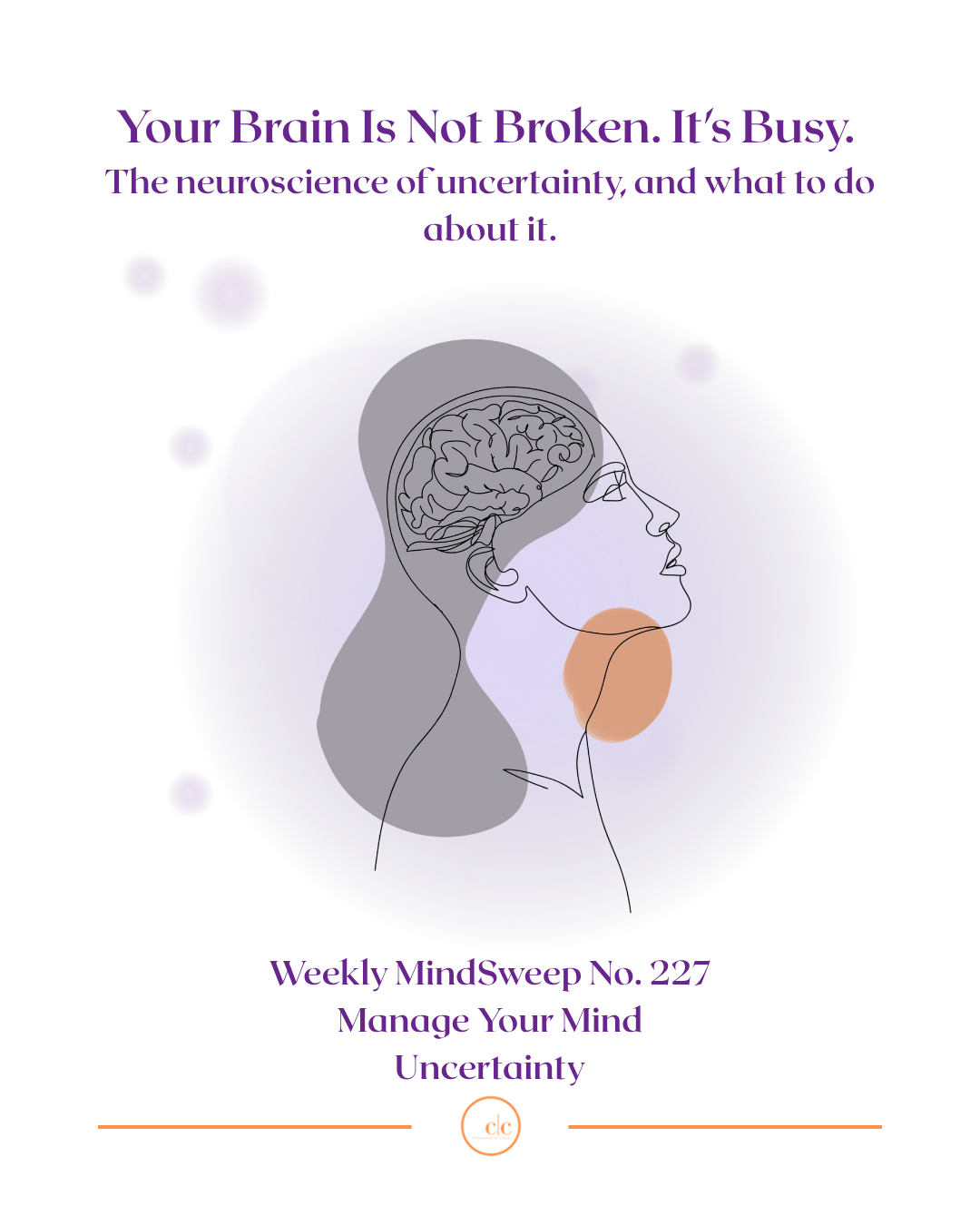
Your Brain Is Not Broken. It's Busy.
The neuroscience of uncertainty, and what to do about it.
It’s a humbling experience to teach something, only to find yourself in a situation where all your knowledge suddenly feels out of reach.
Since March 17th, I’ve been living through a masterclass of uncertainty. Not just the kind that comes with being a creative entrepreneur running a business, but the kind that affects everyone. It doesn’t care about your schedule, your commitments, or even if you teach others how to manage their minds.
My grandmother fell and needed surgery, so I was called to Florida to make medical decisions. I was able to get her into rehab just before my flight home. Two weeks later, I returned for my annual spring visit, where she had a stroke. I advocated for her, negotiated with staff, and got her stabilized and back to rehab, again just before my flight home. Last week, I was called back a third time. She was experiencing memory loss, paranoia, confusion, and an unexplained infection. In a quiet room, I had to make the decision to follow her wishes and move her to hospice care.
In that moment, I was called to quickly learn about things I’d never dealt with before: Assisted Living, Skilled Nursing, Memory Care. Medicare and Medicaid. Medicaid attorneys. 30-day cash payments. Some facilities had no space, and others wouldn’t accept her until we paid in full. I had to move her temporarily while I attempted to sort out the paperwork.
My mind shifted very quickly, from thinking about everyday, to every hour, and then every hour became every minute.
Even though I study and teach about the mind, I couldn’t access my own higher-level thinking during all this uncertainty. I didn’t feel like I was falling apart. It was quieter and harder to describe. My usual way of thinking and finding clarity just wasn’t there. I couldn’t process things or figure out the next step like I normally do.
It felt like I was reaching for a tool and finding it wasn’t where I left it.
So I turned to the people around me. I asked for help and tried to be gentle with myself after every imperfect decision, reminding myself that I was doing my best I could with the information I had available to me in that moment.
And then, something would change.
That phrase sums up these past weeks. Every time I thought I had things under control, something changed. Real uncertainty isn’t one big unknown, but a series of small ones, each hitting before you’ve processed the last.
Yesterday, I settled my grandmother into her long-term care facility. I helped her place a call to her 100-year-old sister. I held her hand. I told her I love her and that she can rest now.
I’m sharing this because this is what uncertainty looks like in real life, not just in theory.
Some of you might be going through your own version of this right now. Your story may be different, but your nervous system is reacting in the same way. You might also feel like you should be handling things better.
You are handling it.
This week, we’ll talk about why that’s true, because understanding what’s happening helps us grow.
The Science: What's Happening Inside
The Alarm Fires
The moment your brain senses something unknown, the alarm fires, your amygdala kicks in within milliseconds, even before you’re aware of it. It doesn’t check if it’s a real emergency or just a delayed email—it always reacts first. Your brain can’t tell the difference between a bear in the woods and a phone call from a Florida area code at 7am. Both feel like threats and trigger the same reaction.
Your nervous system does not grade on a curve.
The Flood
Once the alarm goes off, the hypothalamus signals the pituitary gland, which then signals the adrenal glands, and cortisol starts flooding your body. Your heart rate goes up, your breathing becomes shallow, and your body prepares to fight, flight, freeze, or fawn. Harvard Health research shows that when your brain keeps sensing danger, including ongoing uncertainty, this hormonal loop stays active. It’s not one big rush, but a steady, low hum, like a motor running too long.
During two months of moving in and out of crisis, I didn’t have dramatic breakdowns. Instead, I was running on a constant, quiet drip of cortisol.
That's what chronic uncertainty does. It's not loud. It's just always on.
Your Decision-Making Brain Goes Offline
The parts of your brain responsible for clear thinking—the dorsolateral prefrontal cortex, the anterior cingulate cortex, and the anterior insula—are the same ones that get affected when you’re stressed. Research combining 76 fMRI studies with over 4,000 participants confirmed these areas are key for evaluating risk and making decisions when things are uncertain.
The part of your brain you need most when things are unclear is the same part that goes offline when things are unclear.
That was the tool I couldn’t find. It wasn’t broken or gone, just offline, overwhelmed, and out of reach for a while. Trying to handle Medicaid and Medicare on little sleep with an already stressed ADHD brain wasn’t a failure of intelligence or resilience. It was biology happening in real time.
Knowing that didn’t make the decisions easier, but it did help me stop fighting myself while I made them.
Your Body Is Already Telling You
Before you can even describe what’s happening, your body already knows. Research shows that physical stress responses, like a tight chest, shallow breathing, restlessness, or trouble sitting still or thinking clearly, are directly linked to unpredictable situations.
Not just actual danger. Unpredictability itself.
Tight shoulders at 6am before the phone rang. Not being able to read a paragraph and remember any of it. It felt like I was moving through something heavy. These weren’t signs of failure.
They were data. It was my nervous system accurately reporting the conditions on the ground.
Your symptoms are not drama. They are information.
The ADHD Layer: Why It Hits Louder
If you’re an ADHD or neurodivergent entrepreneur reading this and thinking, "yes, but mine feels like more than what you’re describing," you’re right.
Your baseline is different.
A 2021 study presented at the American Psychiatric Association Annual Meeting found that adults with ADHD scored significantly higher on intolerance of uncertainty, in both their impaired functioning when things are unclear, and their need for predictability. Researchers noted that intolerance of uncertainty may be a core mechanism underlying both ADHD and the anxiety that so often travels with it.
You’re not more sensitive. You’re wired differently. Those aren’t the same thing.
Your dopamine system is working against you here.
The main neurological feature of ADHD is a lack of dopamine signaling, which affects the prefrontal cortex, basal ganglia, thalamus, and amygdala. This network controls executive function, emotional regulation, and decision-making in uncertain situations.
Dopamine is the chemical your brain uses to navigate unclear situations, evaluate options, and move toward action. When that system is underregulated, uncertainty doesn't just feel bad; it disrupts the neurological infrastructure you need to work through it.
Sleep deprivation and ongoing cortisol exposure suppress prefrontal cortex function. Add those on top of an already taxed dopamine system, and what I was experiencing in Florida wasn’t a lack of capability.
It was a brain working under a heavy neurological load, doing the best it could.
Three systems go offline at once.
Research has found three different brain networks that are disrupted in ADHD during uncertainty. The first helps you set goals and picture what you want. The second manages executive function, like comparing options and making choices. The third controls emotional responses through dopamine pathways connecting the orbitofrontal cortex, ventral striatum, and amygdala. When things are uncertain, all three are affected at the same time.
Your navigation system. Your decision engine. Your emotional regulator. All offline, at the same time.
This is why uncertainty for the ADHD brain doesn't feel like mild discomfort. It feels like everything stops working at once. Because neurologically, that is close to what is happening.
And then the loop starts.
When the ADHD brain can’t handle uncertainty, it looks for any kind of certainty it can find. That might mean making lists, double-checking things, researching rather than deciding, seeking reassurance, or rewriting plans. The cycle goes like this: tension rises, your thoughts speed up, you start looking for answers, you get a little relief, then doubt returns, and you start searching again.
During a medical and logistical crisis, this loop meant calling the same facility twice to confirm what I’d already been told, writing out options on paper that I’d already listed, and asking the same question in three different ways—not because I didn’t trust the answer, but because my nervous system needed something concrete to hold onto.
That’s an ADHD brain doing the only thing it knows how to do when dopamine is low and uncertainty is everywhere.
So, what’s a creative ADHD entrepreneur to do to function in a neurotypical business environment?
What You Can Actually Do
Here’s what research and experience have taught me: you can’t think your way out of a dysregulated nervous system. When the prefrontal cortex is flooded by ongoing stress, mindset work and positive reframes don’t have much effect. The brain is in survival mode and needs a physical off-ramp before it can process new thoughts.
Body first. Mind second. Every time. Even when—especially when—it feels like there isn’t time for that.
The exhale is your off-ramp. Breathe in for four counts, out for six to eight, and repeat three times. You’re not just taking a breath; you’re telling your body the threat is over. In hospital waiting rooms, rental cars, and parking lots outside facilities that turned me away, this was often the only tool I had. It worked every time. It didn’t fix everything, but it gave me ten seconds to think clearly.
Orient yourself before you decide. Look around slowly and name five things you can see. Put your feet flat on the floor and notice a sound. These grounding techniques help your brain focus on the present instead of worrying about the future. The present moment is usually manageable, even if the whole situation isn’t.
Move to regulate. Rhythmic movements like walking, pacing, or swaying help regulate your heart rate and the connection between your heart and brain. I walked the halls of several facilities—not because I needed to go anywhere, but because my nervous system needed rhythm before I could think clearly. Five minutes before a tough decision wasn’t avoidance; it was preparation.
Name it to tame it. Label your emotions. Saying, "My prefrontal cortex is offline right now," isn’t giving up; it’s a way to regulate yourself. I told the people helping me, "I can’t access my higher-level thinking. I need you to help me with this." That wasn’t a weakness. It was an honest self-assessment under stress, and it worked.
Reach for your people. Co-regulation matters. The calming effect of a regulated nervous system can be one of the most powerful tools we have. We aren’t meant to handle long periods of uncertainty alone. Relying on someone else’s steadiness isn’t dependency, it’s how we’re built. Your nervous system will appreciate it, even before your pride does.
Give yourself grace in each moment, then move forward.
When uncertainty lasts a long time, you’ll make imperfect decisions. You’ll make them with incomplete information, a stressed brain, and under emotional and physical strain. That’s just reality. The goal isn’t a perfect decision, but the best one you can make with what you know right now.
Coming Back Online
Your brain is doing what it was made to do: protect you from the unknown, even in a world it wasn't designed for.
The uncertainty of entrepreneurship, caring for family, or dealing with a body that doesn't always cooperate isn't proof that something is wrong with you.
I’m back in Massachusetts, sleeping in my own bed, drinking enough water, and eating actual meals. The crisis is not over, but the critical phase has passed, and my nervous system is beginning to remember what regulation feels like.
My thinking is coming back, and I can feel the difference between the brain I had in those hospital hallways and the brain I have right now. In Florida, my awareness was like an intense spotlight: narrow, bright, fixed on whatever was immediately in front of me.
One decision. One phone call. One facility. One moment. Everything else was dark.
Back home, I can feel the gaze widening again. Connections I couldn't make before are starting to surface. I can hold more than one thing at a time. I can think past the next hour. My prefrontal cortex is coming back online, slowly, the way a room brightens when someone gradually raises the dimmer.
That's not a metaphor. That's neuroscience. When the nervous system receives enough safety cues — sleep, hydration, stillness, familiar surroundings, the absence of constant threat — the stress response begins to down-regulate. Cortisol levels drop. The parasympathetic nervous system takes back the wheel. And the higher-order thinking that went offline during the flood quietly returns to its post.
My brain was never broken. It was busy keeping me alive.
Now, I can let it rest.
We are doing the best we can with the information we have right now.
And then, something will change.
Next week, we wrap up. In Week 4 — What's On My Mind — I'll share what this month of uncertainty has taught me, what I'm taking with me, and how we move forward with a little more awareness and a wider gaze than we had before.
My questions for you this week:
When your nervous system goes into uncertainty mode, what does your loop look like? Are you a list-maker, a checker, a researcher, a reassurance-seeker or some combination of all of them
Is there someone in your life whose nervous system you could borrow right now? Who helps you regulate without you having to explain everything first?
Reply and share with me!
✨ You Belong Here. I can help.
Understanding your brain is one thing. Building a business that actually works with it is another, and that's where I come in.
As a brain-based business strategist, I work with creative and neurodivergent entrepreneurs who are tired of forcing themselves into systems that were never designed for the way they think. Together we build strategies rooted in how your brain actually operates, not how productivity culture says it should.
If you've ever thought I know what I need to do, I just can't seem to do it, that's not a willpower problem. That's a strategy problem. And it's exactly the kind of problem I help solve.
It starts with one conversation.
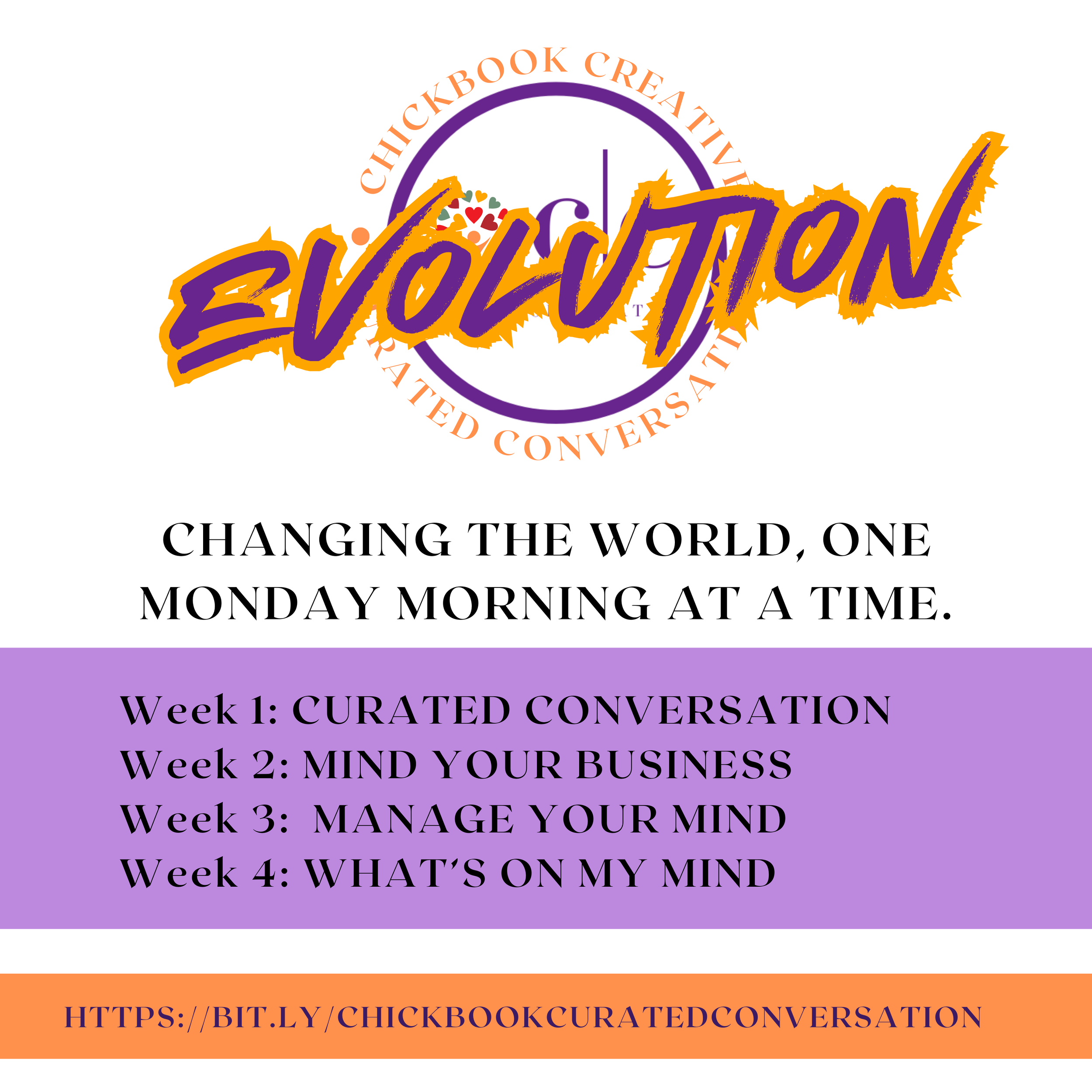
Curated Conversation
You Read It. Now Come Sit In It.
You've been reading the Weekly MindSweep. You've been noticing the patterns. You've been doing the quiet, invisible work of building something real.
Curated Conversation is where you stop doing it alone.
We read together, sit with the hard questions, and close with five minutes of guided meditation with Terri Hamilton. It's the work, in community, in real time.
Your first month is free. Come find out what it feels like to be in the room where it's safe to say the thing out loud.
Listen if you want. Speak if you're ready. Stay if it feels like home.
Mondays at 8 a.m. EST. Start with coffee. Belonging included. 💜
Was this blog forwarded to you? Sign up!
What I’m reading
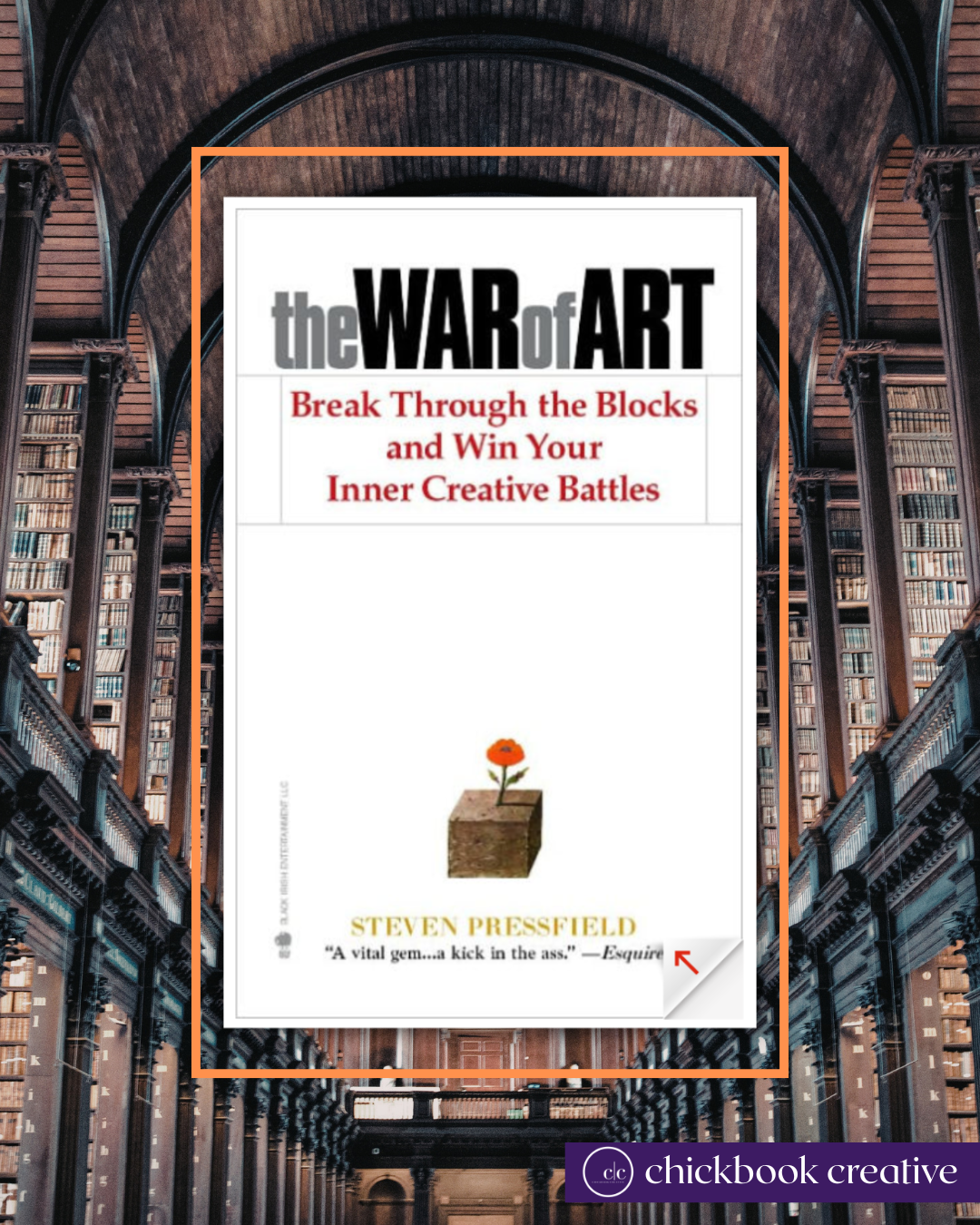
The War of Art
by Steven Pressfield
If you create anything — a business, a brand, a body of work — this book will name something you’ve been living but couldn’t quite articulate.
What has stayed with me is recognizing how sophisticated Resistance can be.



In other news…
Feeling #FOMO about Curated Conversations? Join us!