🧠 Weekly MindSweep No. 208 | Curated Conversation | Value
January 2026
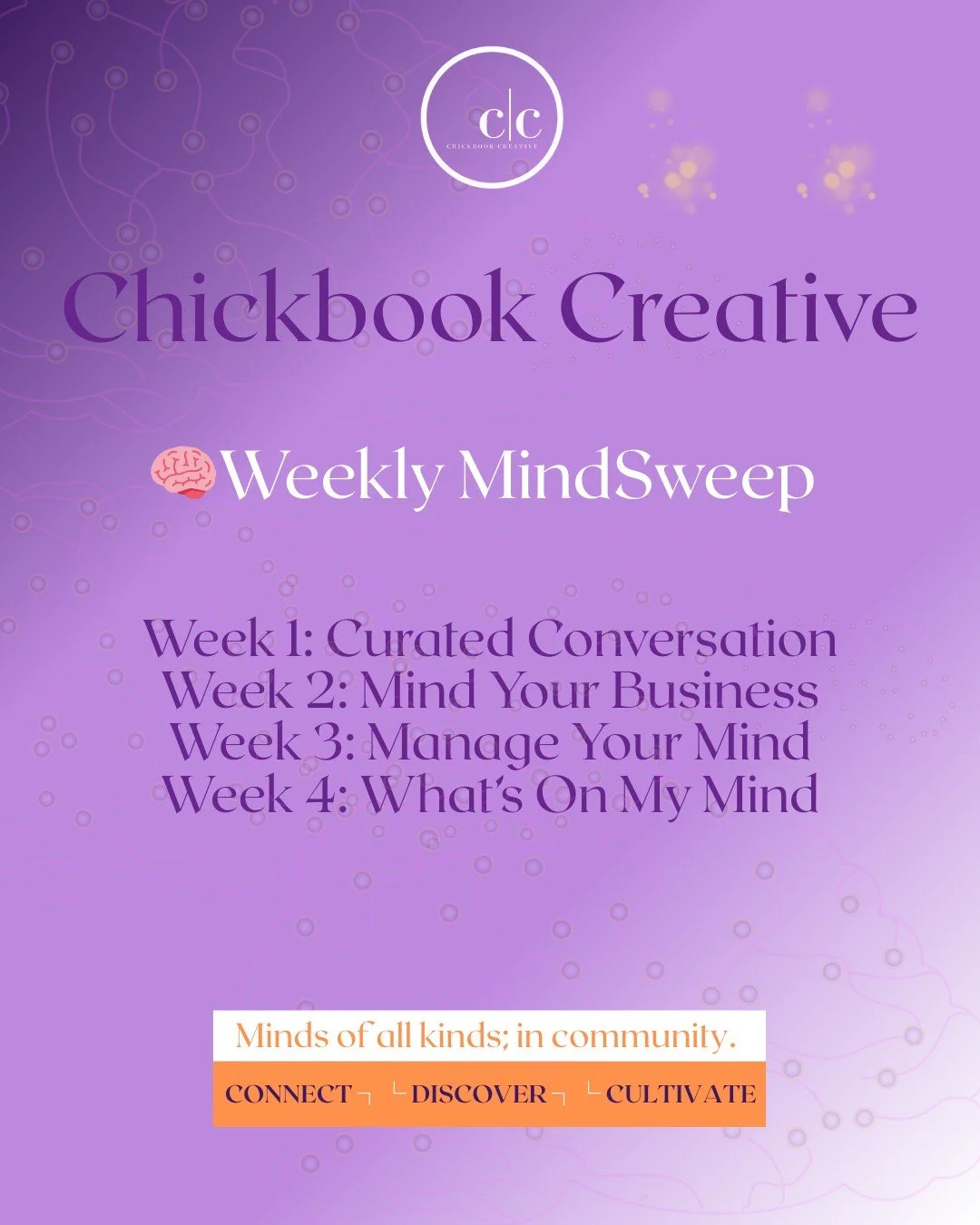
*Week 208: Curated Conversation: Value (4 years!)
Week 209: Mind Your Business: Value
Week 210: Manage Your Mind: Value
Week 211: What’s On My Mind: Value
New to the Weekly MindSweep? Past issues live here.
Let’s Sweep The Brain!
🎬 Rather watch or listen instead of read? Now you can!
Subscribe to YouTube @chickbookcreative
In the MindSweep this week:
Weekly MindSweep: Past issues live here.
Jamie’s Second Brain Corner: Links to references & MindSweep Mapping
Collaboration: with Shannon Giordano and the MetroWest Chamber of Commerce (First Friday of every month)
My face and a link to schedule your free consultation.
Four years.
208 Mondays.
Thank you for reading, reflecting, and being part of this evolving conversation.
If you haven’t replied before, consider this your gentle invitation. I’d love to hear from you!
Value Isn’t Objective. It’s Learned (and It Can Be Changed.)
There’s a pattern I see across nearly every creative business I work with.
Talented, thoughtful entrepreneurs who are doing meaningful, transformative work are pricing their offerings based not on facts, but on feelings. From comparison. From fear. From what feels emotionally tolerable to say out loud.
And over time, that pattern doesn’t just shape income. It reshapes an entrepreneur's identity.
This is why Value deserves a deeper conversation.
Not just as a branding idea, not as a pricing strategy, and not as a stand-in for personal worth. Instead, value is something we learn from our experiences, our upbringing, and our need for safety.
After four years of writing Weekly MindSweep, listening closely, noticing patterns, and encouraging honest reflection, I’ve seen this truth come up again and again:
Value isn’t objective. It’s learned.
We learn what things are “worth” long before we ever price a service or sell a product. We learn it from family dynamics, cultural narratives, early work experiences, and the subtle messages about who gets to ask for more and who gets praised for settling.
As creative entrepreneurs, we carry those lessons with us when we start a business. We build on top of what we’ve learned.
Today is the day that changes.
Value Is Not Objective. It’s Learned.
A common myth in business is that value is objective. People think it exists somewhere in the market, or that there’s a “right” or “fair” number you just haven’t found yet.
But neuroscience, behavioral economics, and our own experiences all show us something different.
Value is learned.
We also learn it from marketing, on top of our money stories,, especially when underpricing is called accessibility and burnout is seen as devotion.
Our brains don’t clearly separate what’s objectively valuable from what we learn to value from others.
Your brain uses the same system to judge value, whether you’re looking at a clear reward or reacting to things like brand reputation, status, or trust. If marketing often links something with pleasure or belonging, your brain learns that connection. Eventually, just seeing a logo, name, or price can make something seem more valuable, even if it’s more expensive.
Your brain creates shortcuts.
Cheap options start to feel risky.
Premium choices start to feel safer.
Certain spaces start to feel like your people.
And all of this happens before logic ever enters the room.
Since your brain judges value automatically, you feel it as a gut reaction or intuition, thinking 'this is worth it,' without noticing the years of learning behind it.
Neuroscience doesn’t tell us what should matter. Instead, it shows that what you treat as valuable over and over shapes the brain circuits that guide where you spend your money, time, energy, and attention.
This isn’t about spending more.
It’s about choosing with clarity.
This means that Value isn’t fixed and can change.
As creative entrepreneurs, we bring these lessons into our businesses, which are often very personal, built on relationships, and closely tied to our sense of self. That’s when things start to get complicated.
When pricing is tied to identity, money stops being about numbers. It becomes about meaning. And that meaning affects everything you do.
How Creative Entrepreneurs Teach the Market Their Value
I notice the same pattern in creative businesses, no matter the industry, experience, or talent.
Most pricing decisions aren’t based on facts. They’re usually based on feelings.
From:
Self-worth
Comparison
Fear
What “people like us” charge
What feels emotionally tolerable to say out loud
Familiar enough that it looks like “what everyone else does.”
Numbers that feel small enough that, if someone says no, we can blame the economy, and not our talent
Instead of:
Actual operating costs
Time & capacity required to deliver the work
How much energy you expend
Your Business’ sustainability
The transformation being created for your client
In reality, you may have never:
Tallied your actual business expenses
Calculated how many hours it really takes to deliver a project from start to finish
Or, considered the transformation your work creates for your clients
Behavioral economics and neuroscience call this subjective value: the brain does not just calculate “objective” worth; it builds value from experience, emotions, and context. Most creatives don’t mean to undervalue themselves. They’re just doing what people do when something feels scary: they avoid looking too closely.
Clarity means you have to make choices. Choices bring responsibility.
Responsibility can feel overwhelming when you already have a lot on your plate—especially with ADHD, where decision fatigue and executive load are already high.
The Avoidance Isn’t Laziness. It’s Protection.
When entrepreneurs don’t fully understand their numbers, it is often not about intelligence or skill. It is a response from the nervous system.
For entrepreneurs without a steady paycheck, money doesn’t come in on a regular schedule. Cash flow goes up and down, timing is important, and income can feel abundant one month and scary the next, even if the business is doing well.
When things are uncertain, the brain does what it’s built to do. It scans for threats.
Looking too closely at the numbers can feel risky. It can bring up shame, fear, and old stories like these:
“If I look, I’ll confirm I’m failing.”
“If I look, I’ll have to make a hard decision.”
“If I look, I won’t like what I see.”
When you add today’s marketing culture, which promises fast results, six-figure incomes, and easy growth, the urge to compare yourself to others gets even stronger.
You’re not just looking at your numbers. You’re comparing them to someone else’s highlight reel, or even worse, your own idea of their success. So, it’s not surprising that avoidance feels safer.
For many ADHD entrepreneurs, money isn’t just stressful; it’s relational.
ADHD, People-Pleasing, and the Cost of Belonging
For many creative ADHD entrepreneurs, there’s another layer running quietly in the background:
Belonging.
If you’ve learned that being safe means being liked, needed, or accommodating, then pricing becomes about relationships, and not just about the numbers.
Rates are adjusted based on what feels comfortable for you or the buyer.
Boundaries become softer in the moment.
Feeling uncomfortable is often explained away as being generous.
And the stories sound convincing:
“People won’t pay that.”
“That feels ridiculous.”
“I don’t want to be greedy.”
“I should be grateful someone wants this at all.”
“Who am I to charge that much?”
“People like me don’t make that kind of money.”
“If I charge more, they’ll expect perfection, and I’ll disappoint them.”
But those thoughts aren’t real business insights. They are old beliefs about money, approval, and self-worth.
The brain doesn’t always tell the difference between emotional rejection and physical danger. So, underpricing becomes a way to protect yourself, over-delivering feels safer, and being exhausted starts to feel normal.
It’s time to take back your power.
You Don’t Decide What Others Value
You do not get to decide how someone else receives your price.
You do not know the reality of whether they see your offer as a stretch, a bargain, or a lifeline.
Their reaction is shaped by their financial reality, their beliefs, their experiences, and their own nervous system history with money. A price that feels impossible to one person can feel grounding to another. A rate that triggers judgment in one body can signal trust in another.
But if you aren’t clear about the value of your work, and your pricing is uncertain or inconsistent, the market doesn’t have anything steady to respond to.
Being clear isn’t arrogant. It’s steady, and that steadiness helps you stay grounded. That’s also why comparison can be so harmful. It shakes your steadiness right when you need it most.
Why “What Others Charge” Distorts Your Reality
Market research has its place.
Context matters, and being aware is helpful. But comparing without understanding can distort your sense of value.
If you set your prices mainly by looking at what others charge,without knowing their business model, costs, or, you’re not really gathering useful information. You’re just taking on someone else’s way of coping.
Often, their strategy has been shaped by similar fears, scarcity, and comparisons.
So low pricing isn’t really set by the market. It comes from a shared nervous system culture of stress and uncertainty. It’s a culture that rewards giving too much, sees burnout as a sign of commitment, and praises access without considering the real cost.
So how do we change that?
We start by making the numbers neutral again.
The Shift That Happens When Numbers Become Neutral
One of the biggest changes I see when entrepreneurs finally look at their real numbers isn’t about money. It’s about how they feel physically.
Their shoulders drop.
Their breath deepens.
Their decision-making steadies.
When you look at numbers without judgment, they become neutral.
They don’t tell you who you are.
They don’t measure your worth.
They don’t define your creativity.
They simply show what it really costs to do the work well.
When you understand that, pricing stops feeling personal. It becomes about relationships, ethics, and sustainability.
It’s not about being cheap or overpriced. It’s about being grounded.
Value Is About Transformation, Not Time
I want to be clear: knowing what an hour of your time costs doesn’t mean you have to (or should) sell your work by the hour. It just means you understand what goes into your work.
The invisible labor.
The cognitive load.
The emotional presence.
The preparation and recovery required.
The years of experience that inform what you do in minutes.
This gives you a floor for packages and projects, not a made‑up “market rate.”
When you know what it really takes to show up fully, you stop turning transformation into just a transaction. You stop apologizing for depth, undervaluing your wisdom, and pretending the work is easier than it is.
And when the market responds, it’s not because you convinced anyone. It’s because you became clear and consistent. That’s why this isn’t just a personal shift. It’s a conversation for the whole community.
Why This Conversation Belongs in Community
You’re not meant to do this work alone. Our relationships shape our stories about money, fear, and value.
That’s also why Curated Conversation is becoming an intentional space where:
Numbers can be looked at without shame.
Clarity is built collectively.
Value isn’t debated, but examined.
You don’t have to brace before speaking.
When safety increases, truth follows. When truth follows, decisions change.
Today is a great day to start looking at your real numbers with compassion. Take the time to understand what it truly costs to deliver the transformations you create. You can then decide, consciously, what an hour of your time is worth.
Not to sell time, but to respect it.
From there, pricing becomes less about “What can I get away with?” and more about “What does it take to sustain the impact I am here to make?”
This Is the Work of our Next Chapter
Today marks four years of writing Weekly MindSweep, and four years of recognizing “the story I tell myself is” has taught me:
Value isn’t something you discover. It’s something you return to by letting go of old beliefs.
It’s there beneath all the noise, the comparisons, and the old ideas about what you’re allowed to want.
And when you quietly reclaim it, you don’t just set prices differently.
You operate differently.
You choose differently.
You lead differently.
You rest differently.
This week, instead of answering “What do I do?” ask:
What feels different for my clients after working with me?
What becomes easier, clearer, or less heavy?
What decisions do they make faster—or stop avoiding?
What do they trust more: their thinking, their voice, their capacity?
Transformation lives in the after, not in the list of features.
When you can name the change you help create, pricing stops being about justification and becomes about alignment.
You don’t have to do all of this at once. Value is not a puzzle you solve. It’s something you return to with one honest look, one steady conversation, one grounded decision at a time.
And you don’t have to do it alone. If you are ready to understand your real numbers to make informed decisions in 2026. You belong here. I can help.
Welcome. This is the conversation we’re having now.
Creative people valuing the transformation they bring and changing the market, one Monday morning at a time.
My questions for you this week:
How has your nervous system been influencing your pricing decisions
What does it look like to reclaim your value quietly without proving, performing, or defending it?
Reply and share with me!
✨ You Belong Here. I can help.
Since you’re already collecting numbers for your taxes, this is a good time to pause and really understand what they mean.
When we work together, you’ll have a safe space to look at what actually happened in your business in 2025, without feeling shame, panic, or pressure to fix things right away.
We separate facts from fear.
We look at the numbers in a neutral way.
Then, we use real information to help you make clear, confident decisions for 2026.
This isn’t just about spreadsheets. It’s about understanding what your work costs, the value you bring, and how to build a business that feels good for you.
If you want to stop guessing and start feeling clear about your numbers, I’m here to help.
Book a free consultation to learn how I can support you and your business.
Curated Conversation
If this conversation sparked curiosity, resistance, relief, or a quiet “yes, this is it,” you don’t have to hold it alone.
Curated Conversation is a weekly, live space for thoughtful, heart-centered entrepreneurs to slow down, speak honestly, and explore topics like Value—without pressure to perform or prove.
We gather to listen, reflect, and make sense of what’s shaping our businesses and decisions together.
If you’ve never joined us, your first month is free. Come sit in the room. Listen if you want. Speak if you’re ready. Stay if it feels like home.
Mondays at 8 a.m.
Start with coffee.
Belonging included.
If you’ve never joined us, your first month is free. Come sit in the room. Listen if you want. Speak if you’re ready. Stay if it feels like home.
Mondays at 8 a.m.
Start with coffee.
Belonging included.
Was this blog forwarded to you? Sign up!
Jamie’s Second Brain Corner:
Words in bold within the Weekly MindSweep are all topics we’ve covered in Curated Conversation. You can dig into them here by searching for the word.

What I’m reading
Eddie Winston is Looking for Love.
Thank you, Liz Heichelbech, of Creative Incites, for this recommendation!
To know me is to know I have a sweet spot for the elderly. What a gift to live inside the brain of a 90 year old looking for his sweetheart. Bring the tissues.
Click on the image to read more.
Collaborations!

Join us Friday, February 6, 2025
Join Shannon and me at the MetroWest Chamber of Commerce with guest speaker Dana Cox of Humanitiv for Designing for Humans: How Understanding Your Customer Drives Real Business Growth. When you look at your business through your customer’s eyes, everything changes. In this session, Dana introduces practical, human-centered design tools to uncover customer needs, remove friction, map the full customer journey, and create clear, trust-building experiences that drive growth with tools you can start using right away in any business or nonprofit setting.
Free: Registration is required: https://bit.ly/MWCoC_Feb2026





In other news…
Feeling #FOMO about Curated Conversations? Join us!