🧠Weekly MindSweep No. 218 | Manage Your Mind | Resistance
March 2026
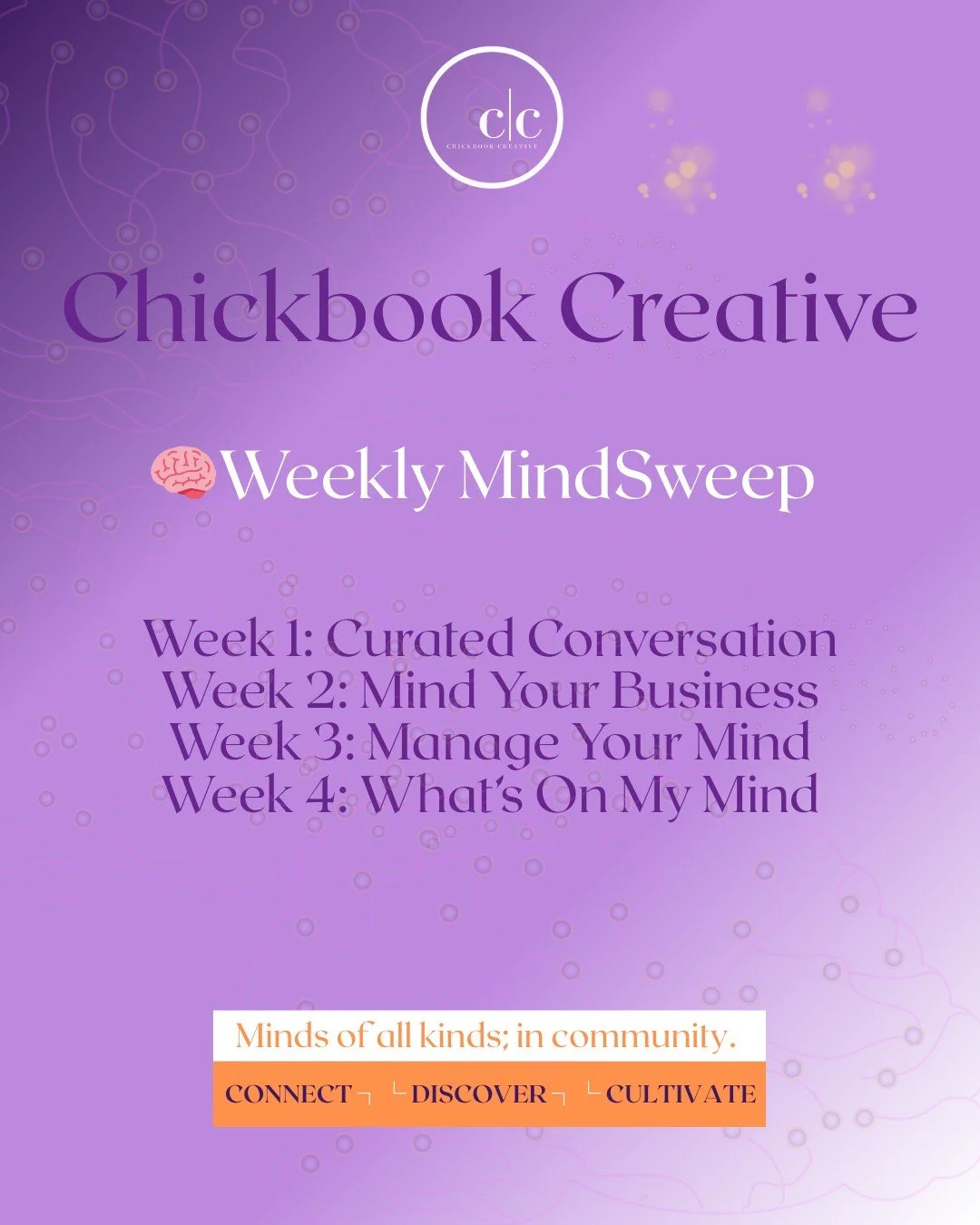
Week 216: Curated Conversation: Resistance
Week 217: Mind Your Business: Resistance
*Week 218: Manage Your Mind: Resistance
Week 219: What’s On My Mind: Resistance
New to the Weekly MindSweep? Past issues live here.
Let’s Sweep The Brain!
🎬 Rather watch or listen instead of read? Now you can!
Subscribe to YouTube @chickbookcreative
In the MindSweep this week:
Weekly MindSweep: Past issues live here.
Jamie’s Second Brain Corner: Links to references & MindSweep Mapping
What’s Inspiring Me - Fawning by Ingrid Clayton
Collaboration: with Shannon Giordano and the MetroWest Chamber of Commerce (First Friday of every month)
My face and a link to schedule your free consultation.
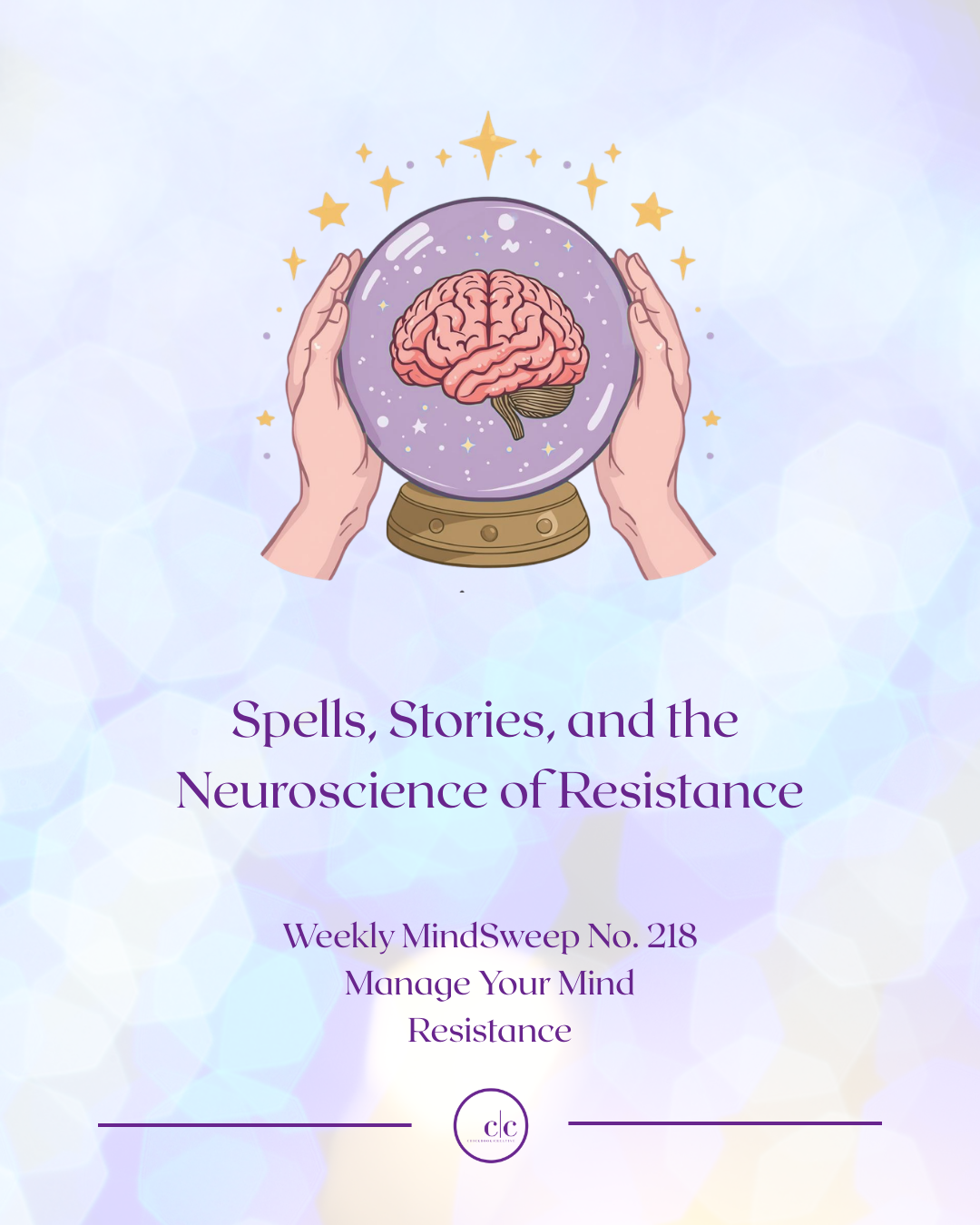
Spells, Stories, and the Neuroscience of Resistance
5 Resistance Practices for Creative ADHD Entrepreneurs
Resistance is your nervous system doing its job, a little too well.
You know the scene. You clear your desk, you make the good coffee, you log in to your computer, and even adjust the brightness on your screen as if it might open a portal to motivation.
You’re ready to finally work on the thing that actually matters: balancing the numbers, the proposal that could change your income, the manuscript with layers of dust, the pitch email to the person you secretly hope will say yes and value working with you.
And then, as if a trapdoor slammed beneath you, you vanish from your own intent, erased by an invisible force.
You end up reorganizing your Google Drive folders, editing old blog posts, trying out new brand colors, or researching project management tools for neurodivergent entrepreneurs, hoping one of these will finally help.
At the end of the day, your bones ache. You slogged through endless tasks, each one crowding your mind. But the very thing that could have transformed everything sits untouched, its open tab burning on your screen, glowing like a silent accusation you can’t escape. The shame hits.
From the outside, this can look like procrastination. From the inside, it feels like a wall you can’t see but always crash into.
If you’ve lived in a creative ADHD body long enough, it can start to feel like a part of your personality:
I’m just someone who doesn’t follow through.
I can’t make myself start.
I’m too much.
We call it resistance or self-sabotage, and sometimes we joke about it because laughing feels easier than facing shame.
Beneath those labels, something simple is happening. Your brain is trying to protect you and is listening closely to how you talk about yourself.
Every time you say “I never finish anything” or “I’m someone who always drops the ball,” your brain doesn’t hear a joke; it hears a rule.
A spell.
A piece of instruction code that the brain is supposed to follow.
Over time, repeating these lines will shape what your nervous system believes is safe, possible, and worth doing.
The Invisible Calculation Your Brain Is Running
Every time you face a meaningful task, your nervous system runs a fast, invisible calculation:
Is this safe?
Is this worth my energy?
Is this clear?
There’s a negotiation between the brain part that scans for threat, the one that chases reward, and the one that steers the ship. If the task feels risky, vague, or too big, the threat system reacts. If the reward seems distant or unclear, your reward system grows bored and wanders off.
The part of your brain that plans and thinks long-term often gets overruled.
On the outside, you might say, “I can’t make myself start.” Inside, it feels more like, “This is scary,” “This doesn’t seem worth it yet,” or “I want to do this, but it’s hard to begin.”
Now add in all of the spells you’ve been casting under your breath for years.
If you keep telling yourself, “I’m someone who doesn’t follow through,” your brain files that as identity, not commentary. When it asks, “Is this safe?” it’s not just scanning the outside world. It’s also consulting the story you’ve told about who you are. Trying and failing doesn’t just threaten a project; it threatens the identity you’ve rehearsed—the one where failure proves you were never really talented.
If you have ADHD, this inner resistance is even stronger. Your brain is exquisitely sensitive to interest, novelty, and urgency. It gets excited about fresh new ideas, starting projects, and things that feel alive right now. It is far less excited by delayed gratification, abstract outcomes, or step‑by‑step maintenance work. #bookkeeping
This doesn’t mean you don’t care, can’t run a business, or lack talent.
It just means your brain doesn’t always get motivated by things just because they look important on paper or a spreadsheet.
If you keep telling yourself, “I’m lazy,” “I’m flaky,” or “I can’t be trusted,” your nervous system starts to see you as unreliable, not just the task as difficult.
Why would it hand you the keys to something vulnerable if the story says you always crash the car?
Why Resistance Is Amplified for ADHD Entrepreneurs
Add creativity to the mix, and things get even more complicated.
A creative brain is a storytelling brain.
When you consider publishing something vulnerable or launching a new offer, your imagination does what it’s best at: it creates vivid stories, often focused on what could go wrong.
You start imagining negative comments, criticism, or a failed launch before anything even happens. You remember times you felt misunderstood or ignored. Your body reacts as if it’s happening now—your heart races, your stomach tightens, and your thoughts scatter like birds.
No wonder you don’t want to open that document.
And then the language kicks in:
See? I can’t make myself start.
I’m too much for this.
If this doesn’t work, it will prove I was never that talented.
Instead of saying what’s really going on:
This feels scary
This is vulnerable
This is new terrain
You speak in verdicts about who you are.
What we call resistance is often your creativity working against you. The same brain that dreams up new ideas can also imagine everything that might go wrong. The same sensitivity that lets you read a room and care deeply about your clients also means your nervous system registers social risk—criticism, rejection, humiliation—as real danger.
When you’re about to click “Post,” “Send,” or “Publish,” you’re not just dealing with distraction. You’re also facing your brain’s warning system, which believes the stories you’ve told yourself over and over and treats them as facts.
From your brain’s perspective, resistance is self-protection. It doesn’t see itself as sabotaging you. It sees itself as shielding you from all of the stories you’ve told it.
The Hidden Fears Underneath Resistance
If you listen closely under the “I just can’t,” you’ll often find very specific fears. Not vague failure in the abstract, but concrete stories:
“If I really show up and this flops, that will confirm I was never that talented.”
“If I send this pitch and they ignore me, it will mean I don’t matter.”
“If this works and my audience grows, I’m not sure I’ll be able to keep it up.”
Your nervous system is working with a history of real moments. Maybe the teacher wrote “not living up to potential” on your report card. Maybe a friend called your business “cute.” There was the launch that landed with a thud, or the post that got silence when you hoped for a chorus of “Yes, I’ll buy that!”.
Over time, those moments turned into beliefs like “I’m not someone who finishes,” “I’m too much,” or “I’m not cut out for this.” Your brain adapts to these repeated messages.
When those memories and words stay with you, resistance acts like a guard, trying to keep you from feeling that pain again.
Resistance isn’t there because it dislikes you, but because it wants to protect you from a world that might not be gentle.
Your own language and the way you talk about yourself have taught your brain that failure means you’re not good enough.
The Procrasti-Working Pattern
For many of us, resistance isn’t laziness. Instead, it’s what I call “procrasti-working”: starting new projects rather than finishing one, over-researching instead of deciding, optimizing systems instead of sending an uncomfortable email, and investing in others’ needs over our own.
Your brain will let you dodge the raw, trembling sting of emotional risk and keeps you busy. For a moment, there’s relief: “See? I did something!” But the real cost is the ache that flares when you ignore the work calling your name. That ache grows sharp, and then it calcifies, hardening into a story: “I must not be disciplined enough. I must not want it enough. Something in me is broken.”
But if we look at it through the lens of your nervous system, your behavior makes sense. You’re following a pattern that fits how your brain weighs risk and reward, and how you’ve been narrating your own capacity.
So what do you do with that?
Working With Resistance Instead of Fighting It
Many of us have tried to push ourselves harder—with more shame, more rules, and thoughts like “I just need to get it together.” This usually leads to a short burst of productivity, then a crash and more self-doubt.
There’s another way, one that treats resistance as information instead of an enemy, and your words as tools instead of weapons.
5 Resistance Practices for Creative ADHD Entrepreneurs
If you notice resistance in your work, try responding with curiosity and small, gentle changes. You can make things easier and start to change the way your brain thinks about these tasks.
1) Shrink the Starting Line: Your brain resists vague, emotionally loaded tasks.
Instead of: write the book, launch the program, fix my marketing.
Try: open a document and write for 10 minutes, draft three messy bullet points, and list the names of three people you might email.
As you do this, try changing your language a little. Instead of saying, “I can’t make myself start,” say, “Starting is hard for my brain, so I’m making it easier to begin.” Small steps feel less threatening, and kinder words help your brain respond differently.
2) Reduce the Distance to Reward: ADHD brains respond to immediacy. Long, nebulous projects with no near‑term payoff are hard sells. Create short feedback loops:
20‑minute work sprints
visible checklists
body‑doubling with another entrepreneur
co‑working sessions with shared accountability
These strategies feed your motivation in real time. Use language that recognizes your effort, like “I’m practicing showing up for 20 minutes,” instead of “It only counts if I do everything.”
Resistance isn’t personal failure; it’s your brain’s protection strategy. By understanding and responding to your brain’s needs with small steps and supportive language, you can overcome resistance and make meaningful progress on your work.
3) Build Safety Around Vulnerable Work: Your nervous system needs psychological safety to create. That might mean:
sharing early drafts with a trusted community first
testing ideas in smaller spaces before a big public launch
giving yourself permission for imperfect experiments
Not everything has to be shared widely at first. In smaller, safer spaces, you can practice saying things like, “This is a draft,” “I’m learning as I go,” or “This is just one try,” instead of feeling like you have to prove yourself.
4) Expand the Story Your Brain Is Telling: When your imagination shows you three ways something could go wrong, add more possibilities. Ask:
What are three ways this could go surprisingly well?
This doesn't remove all risk. It balances the data your brain is using to decide whether something is safe. You’re not forcing yourself into fake positivity; you’re giving your incredibly creative prediction machine more than one channel to tune into.
5) Change the Spells, Not Just the Habits: This is the quieter practice woven through all the others: notice how you talk about yourself when resistance shows up, and experiment with language that is still honest but less fatal.
Instead of “I never follow through.” Try: “Following through is a skill I’m still building.”
Instead of “I can’t make myself start.” Try: “Starting feels sticky for my brain, so I need extra support at the beginning.”
Instead of “If this flops, it proves I’m not talented.” Try: “If this flops, it will sting, and it will also give me information.”
Your brain is listening.
Every repetition is a rep.
If you can’t believe you’re highly capable yet, you can at least stop telling yourself you’re hopeless. Even that small change helps your nervous system.
The Reframe That Changes Everything
The most radical shift to consider this month?
What if resistance isn’t your enemy at all?
What if it’s simply the part of you that loves you enough to pull the brakes when things feel too fast, too exposed, and too uncertain? What if your work as a creative ADHD entrepreneur isn’t to bully that part into silence, but to earn its trust? To show it, gently, over time, “We can do this differently. I won’t throw us off a cliff. I’ll take smaller steps. I’ll listen when you say ‘too much.’
I’ll build scaffolding that actually fits this brain. I will stop speaking about myself like I am the problem.
You are not lazy. You are not a walking pile of half‑finished projects because you don’t care.
You are a highly sensitive, highly imaginative nervous system trying to build something real in a world that wasn’t designed for your pacing, your passions, or your pain points.
Resistance is not the villain of that story.
It’s the part of you saying, “Please don’t forget about me while you chase the next big thing.” And your words—the ones you repeat about who you are and what you can or can not do, are the spells that teach it, whether growth is always dangerous, or sometimes, possibly, a place you’re allowed to go.
This month, instead of making it something to conquer, you’re allowed to treat resistance as something to understand and choose to talk to it differently.
My questions for you this week:
When you notice resistance in your work, what story do you tell yourself about it? How could repeating that story affect your willingness to try again?
Where do you notice resistance in your business? If it is trying to protect you instead of holding you back, what could it be asking for—clarity, support, safety, time, or something else?
Reply and share with me!
✨ You Belong Here. I can help.
If you keep running into resistance when trying to do your most important work, the issue might not be a lack of motivation. It could be a lack of clarity, stress in your nervous system, or a strategy that just doesn’t fit your brain.
In a MindSweep Mapping Session, we slow everything down, sort through the competing thoughts and pressures in your head, and map a path forward tailored to your unique thinking style. By the end, you'll have actionable steps, renewed confidence, and a clear sense of direction.
If you’re ready to stop wrestling with resistance and start building momentum, take the next step and decide if you want a free consultation to talk through your current state or book your MindSweep Mapping Session now.
Curated Conversation
If this conversation resonated, you don’t have to navigate resistance alone. Curated Conversation is a weekly live space for heart-centered, ADHD-wired entrepreneurs to slow down, reflect together, and understand what resistance is actually protecting, rather than shaming themselves for feeling it.
We look at the subtle stalls. The overthinking. The “I’ll start tomorrow.” We untangle avoidance from nervous system overwhelm and create small, supported movement forward.
If you’ve never joined us, your first month is free. Come sit in the room. Listen if you want. Speak if you’re ready. Stay if it feels like home.
Was this blog forwarded to you? Sign up!
Jamie’s Second Brain Corner:
Words in bold within the Weekly MindSweep are all topics we’ve covered in Curated Conversation. You can dig into them here by searching for the word.

What I’m reading
Fawning.
I’m inspired by the shift from performing for worth to living from inner alignment, where success, visibility, and money feel safe because they’re rooted in self-worth, agency, and self-compassion.

Business Community & Collaboration
Be sure to join us in before our final gathering, June 2026!
Friday, April 3, 2025 Join Shannon and me at the MetroWest Chamber of Commerce for this special session. Different Thinkers. Stronger Teams. Autistic and AuDHD professionals offer valuable strengths like focus, creativity, integrity, and systems thinking. However, many workplaces are not set up to support the way they work best.
In this session, Melissa K. Berger from thriving with autism will talk about the hidden challenges that can slow teams down. She will share simple, practical changes that help neurodivergent team members do their best work, leading to better collaboration, productivity, and innovation for all.
Free: Registration is required: https://bit.ly/MWCOC_April2026





In other news…
Feeling #FOMO about Curated Conversations? Join us!