🧠 Weekly MindSweep No. 205 | Manage Your Mind | Belonging

December 2025
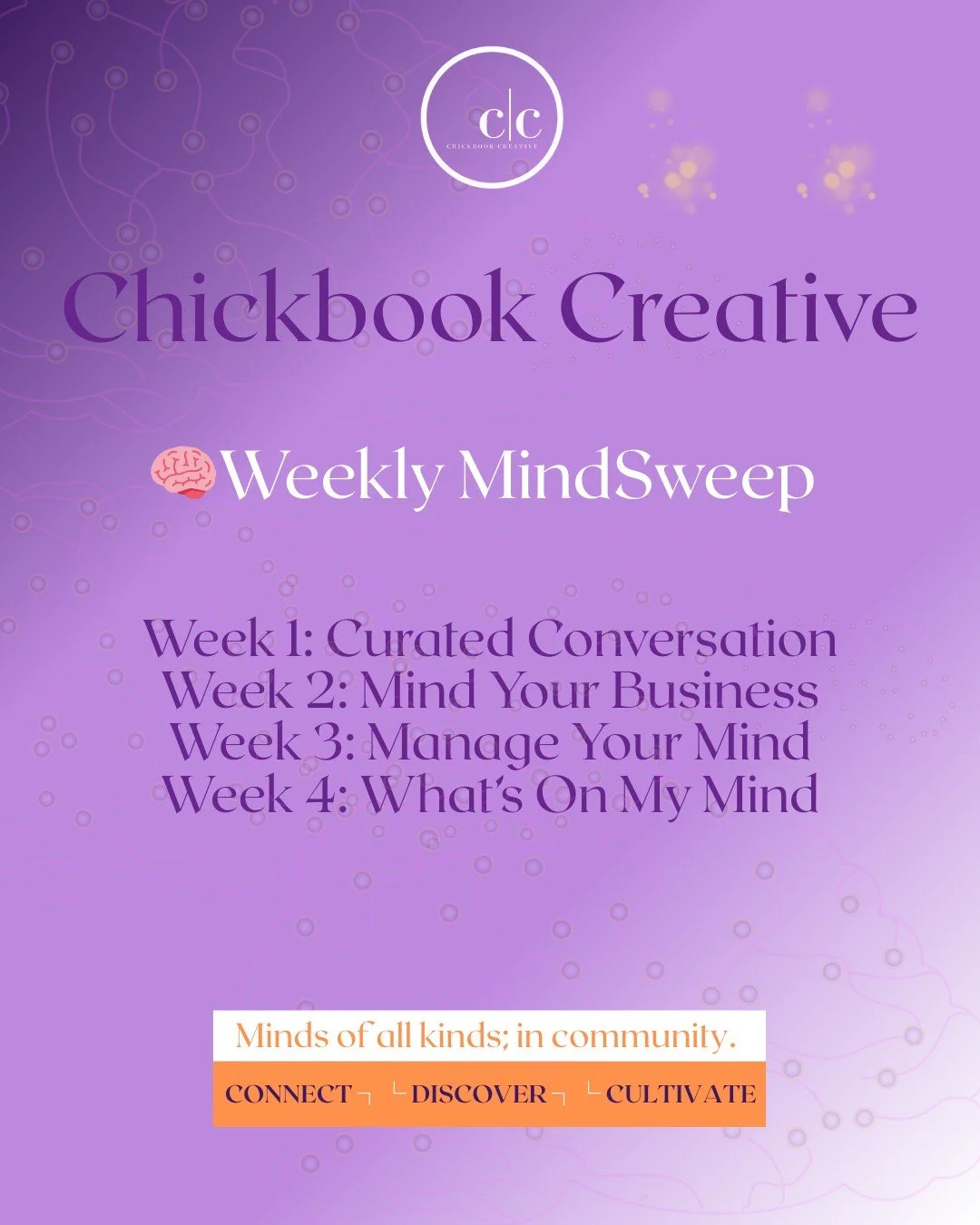
Week 203: Curated Conversation: Belonging
Week 204: Mind Your Business: Belonging
*Week 205: Manage Your Mind: Belonging
Week 206: What’s On My Mind Belonging
Let’s sweep the brain…
🎬 Rather watch or listen instead of read? Now you can!
In the MindSweep this week:
Weekly MindSweep: with curated GIF’s & puns (for your entertainment).
Jamie’s Second Brain Corner: Links to references. Need a map? I’ve got you!
What’s Inspiring Me: The Art of Self-Approval by Elaine Blais
Collaboration: with Shannon Giordano and the MetroWest Chamber of Commerce (First Friday of every month)
My face and a link to schedule your free consultation.
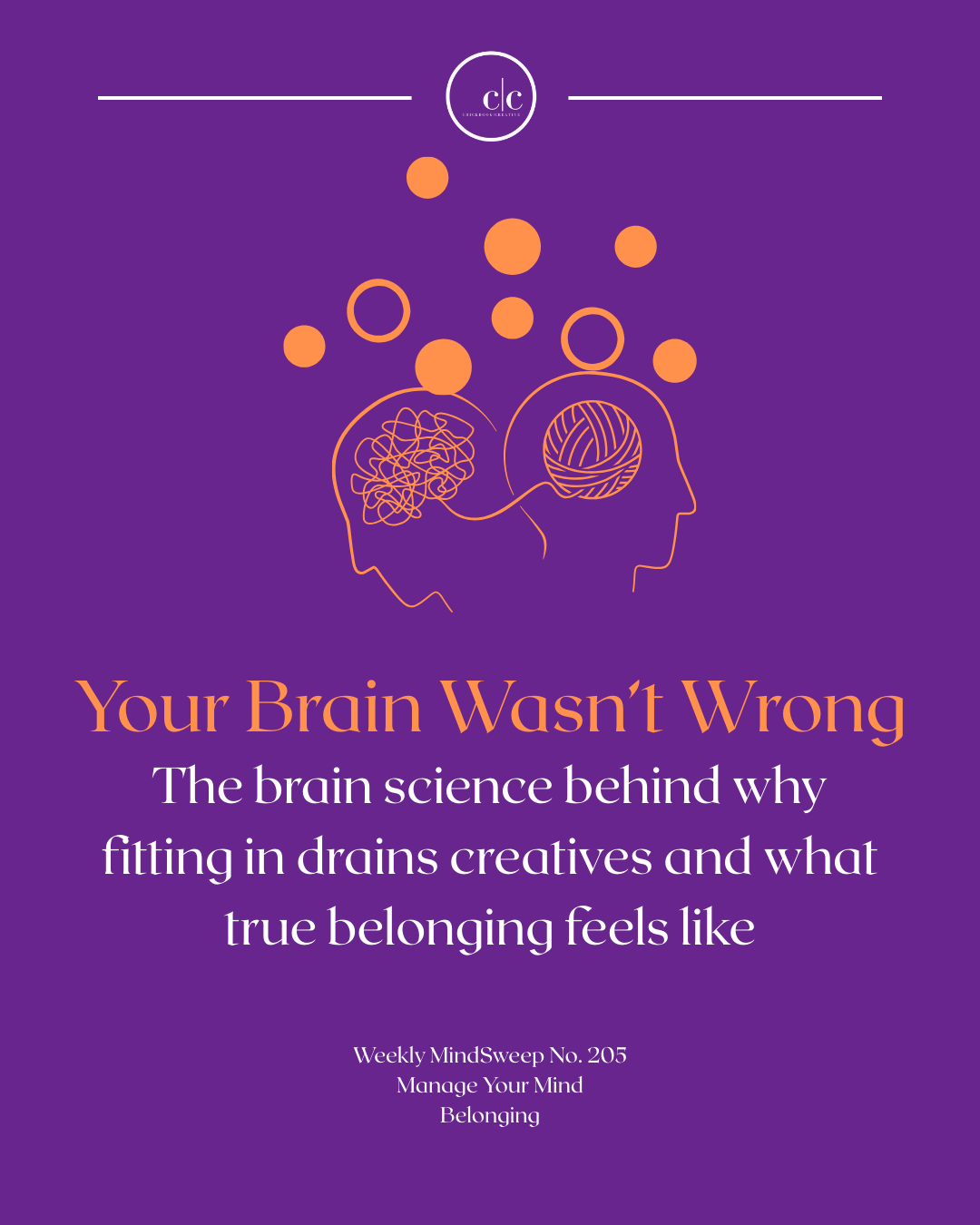
Your Brain Wasn’t Wrong
The brain science behind why fitting in drains creatives and what true belonging feels like.
When Chickbook Creative came online in 2020, I found myself trying to fit in everywhere.
Not casually or curiously, I wanted “in” with the kind of intensity that makes you try harder than you should. I admired many of the groups I joined. The people there were bright, polished, and respected. They spoke the language of success fluently: metrics, milestones, mastery!
So I did what my ADHD, pattern-seeking brain does best: I studied the room.
I paid attention to how fast they spoke, how clearly their ideas landed, and which words got nods or made things awkward. Slowly and quietly, I started to notice that I had changed how I expressed myself.
I simplified my thoughts, held back my curiosity, and changed my ideas so they would be accepted instead of being fully honest.
On the surface, it seemed like I belonged. I was invited, included, and sometimes even praised. But my brain and body were telling a different story.
Every meeting took a lot of effort. Every time I spoke up, it felt risky. Every success left me tired instead of energized. At the time, I didn’t have the words for this:
These groups wanted results, not the way my mind works.
Those are two very different things. Belonging isn’t just about being allowed in. It’s about whether the group can truly accept you once you’re there.
I wasn’t failing to belong.
I was trying to fit in somewhere that wasn’t made for my way of thinking, and no amount of skill could change that.
This experience brought me the gift of clarity. When you have to change yourself to belong, it’s not really belonging; it’s just getting by to “fit in.”
The Neuroscience of Belonging (Why This Hits So Fast)
Belonging isn’t just a social preference or a personality trait. It’s a biological signal. In your brain, belonging sits where your social instincts and your threat-detection system meet.
When you feel connected, your brain can focus on creativity, reflection, and finding meaning.
The default mode network (DMN), which includes areas like the ventromedial prefrontal cortex and anterior cingulate cortex, helps you maintain a clear sense of who you are and how you relate to others. This network lets you think:
This is who I am, and this is how I fit.
But when you feel your sense of belonging is threatened, your brain doesn’t stop to consider the details or intentions. Your amygdala and other brain networks start looking for danger in small social cues: pauses, changes in tone, unread messages, or no response.
Instead of seeing these as neutral, your brain treats them as possible rejection. At the same time, the parts of your brain that help with language,understanding others, and making decisions can also stop working.
This change explains why feeling left out can be so upsetting. Loneliness and social disconnection affect how different brain networks connect, making it harder to think clearly, regulate emotions, or even focus.
For creative people with ADHD, who are already more sensitive to stimulation, emotion, and new things, this signal comes on faster and stronger. The nervous system quickly jumps to all-or-nothing thinking:
I’m too much.
I don’t belong.
I should disappear or over-perform.
This isn’t just overthinking. It’s your brain processing threats more quickly.
When your brain feels your belonging is at risk, it doesn’t focus on being accurate. It focuses on keeping you safe.
How This Shows Up in Entrepreneurship
In entrepreneurship, belonging isn’t about being popular or liked. It’s about feeling safe for how your mind works.
Because entrepreneurship involves being seen, judged, and interpreted by others every day, threats to belonging happen more often than we think.
One common trigger is talking about pricing and proposals. If someone pauses after you share your rate or asks for clarification, it can feel like they’re judging your worth, not just your offer. For people with ADHD, identity and work are closely connected. In those moments, we might lower our prices, add more to the offer, or over-explain to feel like we belong again.
Another trigger might be visibility and marketing yourself. Sharing your authentic voice, talking about your different way of thinking, or even mentioning neurodivergence can set off the same threat signals as entering a room where no one thinks like you.
Even if people don’t react, your brain might see silence as being left out.
Group spaces can either help you feel safe or leave you feeling unsettled. Masterminds, Slack groups, and collaborations can foster belonging through shared language and safety, or quietly undermine it through hierarchy, fake vulnerability, or subtle exclusion.
Brené Brown describes shame as the fear of disconnection: If they really see this, I won’t belong.
Adam Grant’s research shows that creativity and idea-sharing increase when people know they can speak up, experiment, and be wrong without penalty.
Put together, the takeaway is simple and profound:
Your brain does its best work when the environment signals that you can be fully seen here and still belong. These are not just affirmations, they’re neural reps—small, repeatable actions that teach your brain a new association:
It teaches your brain that being different and visible does not mean you’re in danger.
Five Brain-Based Ways to Rewire Belonging
Here are five Brain-based ways to rewire belonging for your brain.
1. Name the Cue, Not the Character
When you feel that sinking feeling, the goal isn’t to fix the thought. It’s important to notice and name the signal.
“My brain just flagged a belonging threat.”
“This is protection, not proof.”
Naming what you’re feeling helps your brain stay calm and present, instead of making you hide, shape-shift, mask, or shut down.
2. Build Psychological Safety Before the Room
When you feel threatened, your brain tries to change everything in the middle of a conversation. Don’t let it.
Write down your prices, boundaries, and what you’re willing to negotiate before important conversations. Decide these things ahead of time so your nerves don’t take over in the moment.Afterward, ask:
Where did my brain assume exclusion?
Where was the evidence neutral or welcoming?
Feeling safe helps you come up with more ideas, even if you create that safety for yourself.
3. Choose Rooms That Can Hold Your Wiring
Belonging depends on the situation. Your brain is always asking, Who thrives here?
Look for spaces where it’s normal to think differently, need stimulation, or be sensitive to rejection. After being in a group, ask yourself:
Do I feel more like myself or less?
The places you spend time in regularly shape how your brain works in the future. (Who you surround yourself with matters.)
4. Practice Edges, Not Emotional Flooding
Being vulnerable doesn’t mean sharing everything. It means showing parts of yourself to people who have earned your trust.
Share a little at a time. Then notice:
Did I stay? Did the group support me?
This question helps you build resilience to shame, so you can stay true to yourself even when your brain expects to be left out.
5. Script Belonging for High-Threat Moments
When you feel stressed, it’s hard to improvise. Having scripts gives you support.
Scripts support your thinking and make it easier to respond, slow down your reactions, or give your brain a familiar path to follow when you feel threatened. The goal isn’t to sound perfect, but to stay calm and true to yourself.
Prepare with an opener, a pause, or a boundary.
An opener helps you feel grounded before you get feedback from others. It also helps stop the urge to over-explain to fit in.
“I tend to think out loud and connect ideas as I go—feel free to stop me if you want me to slow down or clarify.”
“I’m going to share a half-formed thought—naming it as I’m still working it out.”
A pause line helps you stop and think before you speak. It keeps you present without trying to please others or withdraw.
“That’s a great question—let me think out loud for a second.”
“I want to pause and make sure I’m answering what you’re actually asking.”
“Let me take a beat and come back to that.”
A boundary sentence helps you stick to your values instead of reacting out of panic. It keeps your behavior clear and true to yourself.
“I don’t discount my rates, but I’m happy to adjust scope if needed.”
“I’m not available for that level of urgency, but I can respond by [time].”
“I’m comfortable sharing that much, and I’m going to stop there.”
Using clear language makes it easier to think and helps you act from your values, not from fear.
The First Room Where I Didn’t Have to Translate Myself
A year after moving through rooms not designed for my brain, I stopped trying to translate myself and built one instead—the Chickbook Creative Community.
It was the first space where I didn’t rehearse before speaking, where I could share half-formed thoughts without apologizing, where I could jump tracks mid-sentence and name connections before I could explain them.
And no one flinched.
Someone leaned in and said, “Wait—say that again. I think I know where you’re going!”
No one asked me to tighten it up. No one rushed me to the point. No one mistook my process for incompetence.
My body noticed before my brain did. My shoulders dropped. My breath slowed. My ideas expanded instead of shrinking.
That room became a community of belonging.
It wasn’t perfect, and not everyone thought the same way. But it was a space designed for how our brains really work. The safety of thinking in a nonlinear way wasn’t a problem, curiosity wasn’t seen as disruptive, and talking through ideas out loud wasn’t something to apologize for.
For the first time, I didn’t have to change myself to belong. And if you’ve ever been wanted for your results but not for your process, been included yet still felt invisible, wondered why success felt so draining, your brain wasn’t wrong.
You were not being “too much.” You are not broken. And you were certainly not failing to belong.
You were trying to fit in with rooms that valued only your output, not your wiring.
Belonging isn’t about being picked by a group. It’s about choosing or creating spaces that support how you think, create, and connect. That’s not just a change in mindset. It’s wisdom from your nervous system.
Belonging isn’t something you earn by performing. It’s something your nervous system recognizes when it finally feels safe.
Your body already knows where you belong. Trust it.
My questions for you this week:
What would change in your work if you trusted that being different and visible doesn’t automatically mean danger?
What does real belonging feel like in your body when it’s present. What helps you recognize it when it shows up?
Reply and share with me!
✨ Build Belonging Into Your Business
I work with creative and neurodivergent entrepreneurs who are tired of forcing themselves to fit into systems, strategies, and spaces that weren’t built for their brains.
Through MindSweep Mapping and small-group experiences, we slow things down, make sense of what your nervous system is signaling, and build a business that supports how you actually think and work.
If you’re curious, start with a conversation.
No fixing. No performing. Just clarity.
🧠 Your brain. Your business. Mapped.
👉 Book your free MindSweep Chat: www.chickbookcreative.com/mind-sweep
Already know you’re ready to build something powerful, sustainable, and true to you?
👉 Book a free consultation to explore how I can support your business and your brain — as a strategist, creative partner, and thought-partner who actually gets how you’re wired.
Was this blog forwarded to you? Sign up!
Jamie’s Second Brain Corner:
The words in bold within the Weekly MindSweep are all topics we’ve covered in Curated Conversation. You can dig into them here:
Did someone say MindSweep MAP?!
Follow Chickbook Creative on Substack!
NEW>> Now on Apple Podcasts!

MONDAY: 8 am - Curated Conversation - Zoom
Changing the world, one Monday Morning at a time. Learn more + Sign Up for a Monday morning reminder!

What I’m reading
The Art of Self-Approval: Midlife as a Sacred Return to Yourself
by Elaine Blais
Elaine Blais—friend, mentor, creative force, and a grounding presence in our Curated Conversations—writes with a truth-telling that goes straight to the heart. Hearing her voice rise from the page was a gift every midlife woman deserves to experience.
What if you were never the problem?
What if there was nothing to fix—only more of yourself to remember?
For generations, women have been conditioned to play small, chase perfection, and earn approval by being agreeable, productive, or “good.” But the truth is simple and liberating: there was never anything wrong with you. You don’t need fixing—you need remembering.
The Art of Self-Approval is Elaine’s invitation to reclaim the parts of yourself you’ve hidden, quieted, or abandoned. Through honest storytelling, grounded reflection, and practical tools, she shows you how to:
Break free from people-pleasing and self-abandonment
Rewrite your stories with compassion
Stop negotiating your worth
Trust your inner voice and choose yourself
Part memoir and part spiritual companion, this book is a gentle rebellion against a culture built on women’s self-doubt. Elaine’s midlife reinvention—marked by truth-telling, boundary-setting, and sourdough baking—reveals what becomes possible when you nourish what matters.
If you’re in the messy middle of midlife, craving change, or simply done asking for permission to be yourself, this is your guide home.
You are not here to improve. You are here to remember you are already whole.
Find it where you browse for books.
Collaborations!

Join us Friday, January 2nd, 2025 from 9am-11am.
Join Shannon and me at the MetroWest Chamber of Commerce
We'll discuss ways to cultivate business through Sales, Marketing, and Communication methods that support relationship building, showing up authentically, and connecting deeper with colleagues and the people you serve.
9-11 am - Open discussion, community support, brainstorming ideas.
Join us in meeting business owners in our community. You'll leave with new tools to help you make connections and build your business!
Free; Registration is required: https://bit.ly/MWCoC_January2026



In other news…
Feeling #FOMO about Curated Conversations? Join us!