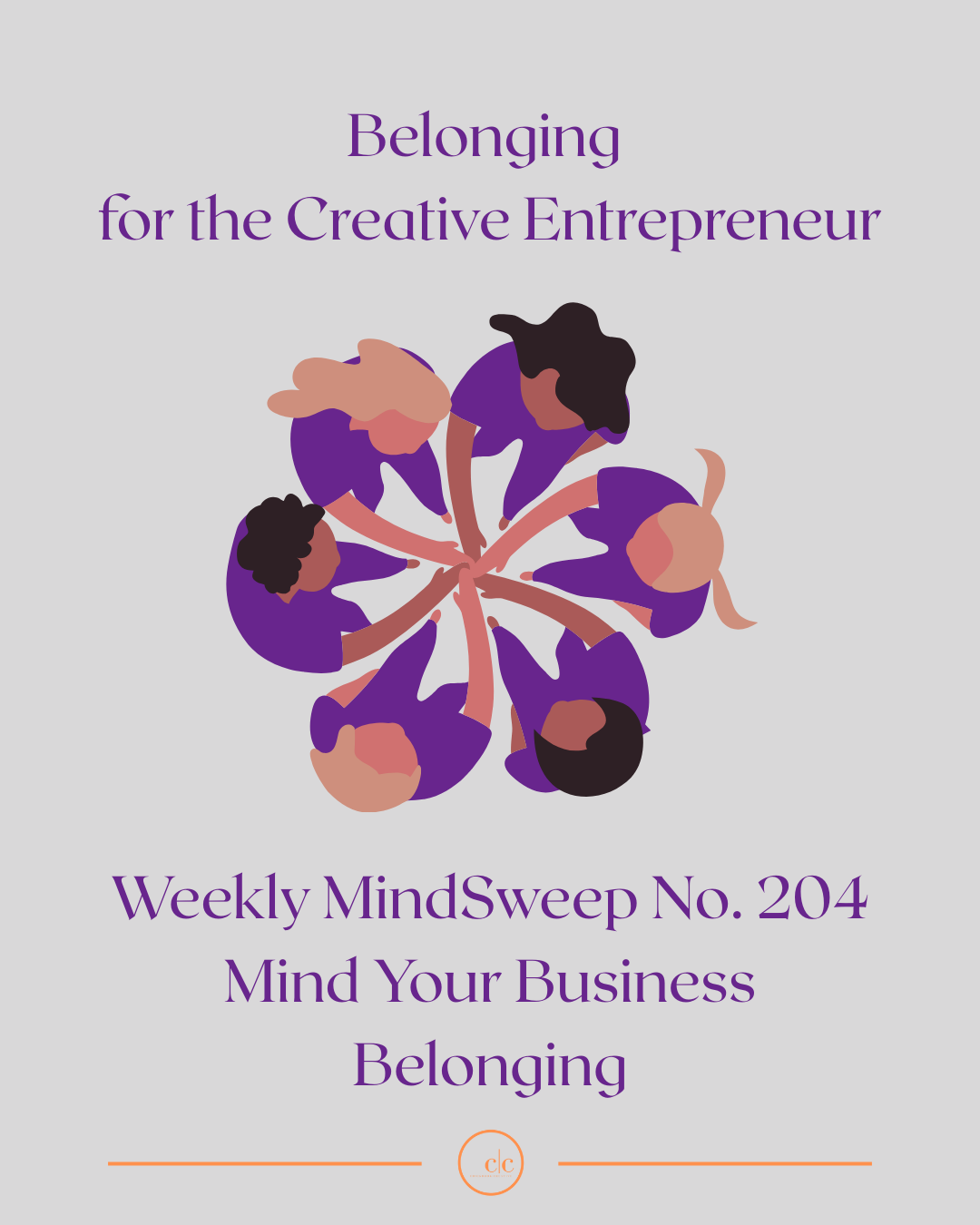
🧠 Weekly MindSweep No. 204 | Mind Your Business | Belonging

December 2025
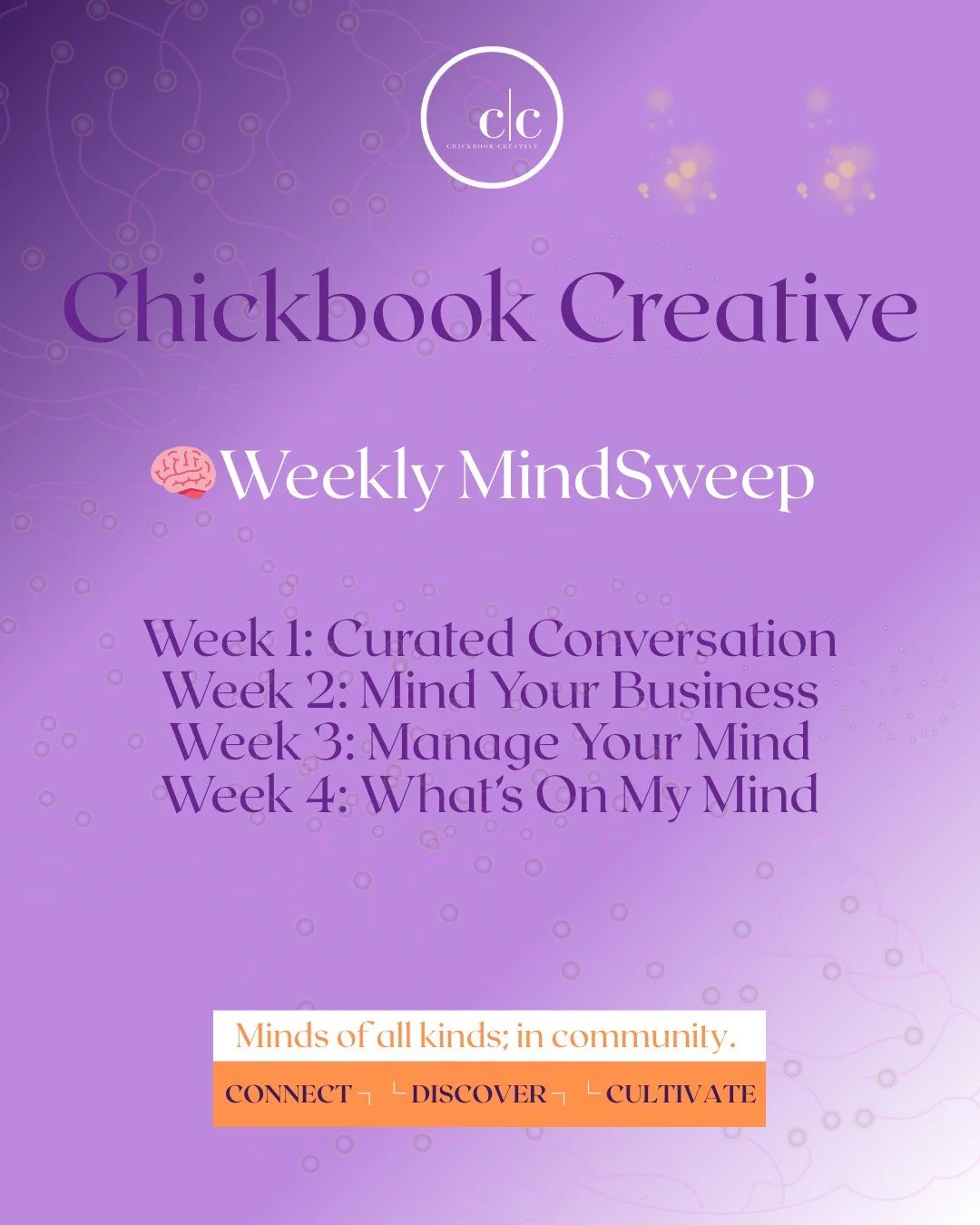
Week 203: Curated Conversation: Belonging
*Week 204: Mind Your Business: Belonging
Week 205: Manage Your Mind: Belonging
Week 206: What’s On My Mind Belonging
Let’s sweep the brain…
🎬 Rather watch or listen instead of read? Now you can!
In the MindSweep this week:
Weekly MindSweep: with curated GIF’s & puns (for your entertainment).
Jamie’s Second Brain Corner: Links to references. Need a map? I’ve got you!
What’s Inspiring Me: The Art of Self-Approval by Elaine Blais
Collaboration: with Shannon Giordano and the MetroWest Chamber of Commerce (First Friday of every month)
My face 💜 and a link to schedule your free consultation.
Belonging for the Creative Entrepreneur
Why Some Spaces Feel Wrong and How to Find (or Build) the Ones That Feel Like Home
In 2020, when the entire world was turning upside down, I re-entered the entrepreneurial space in the only way we could: by moving online. After the exhausting experience of running businesses from our dining room tables, we were all searching for something steady and for somewhere we belonged.
I joined Facebook groups, masterminds, free and paid communities, and groups of networking circles. I found myself in countless Zoom meetings with strangers, all trying to connect through a Brady Brunch screen of blended humans.
With each new space I entered, my nervous system quietly asked the same question:
“Is it safe to be myself here?”
And each time, the answer came a bit too quickly: “Hmm… maybe not.”
For a neurodivergent brain—one wired for pattern recognition, emotional nuance, and deep authenticity—those subtle signals land hard and fast.
Some spaces were drenched in the neon-pink hustle culture. That “Rise and grind!” mentality felt like punishment to the soft, intuitive way my brain operates. Others were so narrowly focused that creativity felt like a burden. Some claimed to be inclusive but practiced quiet exclusion or insisted on a “play bigger” mentality before even learning my name. Many were so polished that perfection suffocated authenticity—with flawless backgrounds, scripted talking points, and perfectly curated individuals who seemed devoid of ever having experienced a messy journey.
In every one of these environments, a tightness formed in my chest. You know this feeling, that spark behind your sternum that signals: “This isn’t my room. These aren’t my people. I don’t belong here.”
And perhaps most importantly, I felt: “I don’t feel safe bringing all of me.”
Eventually, after many self-regulation breaks, deep breaths and long walks in nature, I realized something pivotal. I wasn’t searching for a specific demographic, niche, or industry.
I was looking for a particular mindset—a creative, neurodivergent, heart-first mindset.
A multi-passionate, curious, intuitive, and wildly imaginative perspective. A brain that didn’t need to perform to be valid. One that questioned hustle culture instead of idolizing it. I wanted a mindset that valued humanity just as much as strategy.
A mindset like yours.
When I couldn’t find a space that genuinely honored those kinds of minds, I recognized the importance of intentionally creating an environment that fosters belonging for creative, multi-passionate entrepreneurs.
And so, I created one.
The Chickbook Creative Community is an ecosystem for the creatively wired, the outside-the-box thinkers, the neurodivergent entrepreneurs, and those who wish to lead with heart rather than urgency.
It’s not just a club or organization; it’s a room where an individual’s identity doesn’t matter as much as their mindset.
Our community demonstrates that belonging is intentionally cultivated, fostering safety and trust through an understanding of biological, social, and identity needs, all of which are approached with daily and weekly practice and clear intention.
How Belonging Shows Up in Business
This week, let’s get curious about how belonging shows up in our creative lives and businesses. Belonging in business is different from belonging socially. It’s not just emotional; it also affects us operationally. It impacts:
Visibility
Pricing
Confidence
Creativity
Collaboration
Risk-taking
Clarity
Capacity
When you feel like you belong in a room, you:
offer ideas without rehearsing them 12 times first
speak in your natural voice instead of your “professional translation” version
charge in alignment instead of apologizing for your invoice
collaborate instead of comparing
let your creativity lead
take strategic risks
allow yourself to be seen
And when you don’t feel like you belong, you:
shapeshift
mask
minimize
over-deliver
undercharge
apologize
hide your brilliance
shut down your creativity
monitor every word coming out of your mouth
For neurodivergent creative entrepreneurs, this happens fast. Before your conscious mind has a chance to process, your nervous system is already scanning for cues of safety.
Our wiring allows for heightened awareness and observation. When we enter a networking event, we instinctively notice patterns, such as groups of people who already know each other, the host’s demeanor, and whether the atmosphere is welcoming or exclusive.
We recognize the energy in the room—whether it’s fast and frantic or warm and inviting—and we discern whether the conversations are inclusive or hierarchical. While we might casually label these sensations as “vibes,” in reality, our brains are interpreting them as threats or signs of safety.
A cold room = threat - A speedy introduction round = threat - A dismissive glance = threat - A table filled with insiders = threat - A host who doesn’t acknowledge you = threat
Because our beautiful brains are pattern-spotting machines, we don’t just see these cues; we forecast and predict outcomes based on them.
Which is why many of us leave networking events thinking:
Something felt off.
I don’t think I belong there
I must not be the right kind of entrepreneur.
Maybe I’m too much…or not enough.
For many creative entrepreneurs, unfamiliarity registers as danger until proven otherwise. We genuinely experience these feelings, even if the reality is that the environment simply isn’t a good fit for us. Yet, sometimes, our nervous system just needs more information.
Belonging is a biological experience before it becomes an emotional or intellectual experience.
Let’s explore what the different layers of belonging can look like within our communities.
Three Layers of Belonging in Business Communities
1. Biological Belonging
Our body’s first question is “Am I safe here?”
This is instinctive, automatic, and primal. We may not actually be disengaged; we’re assessing risk.
2. Social Belonging
Our next question is: “Do I connect here?”
Not performatively, but relationally. Are people open? Curious? Conversational? And, is there room for difference?
Is it safe to be myself, or should I mask myself?
3. Identity Belonging
And the deepest layer is: “Do I see myself reflected here?”
Do the values match? Do the minds feel familiar? Do I recognize my pace, my creativity, my heart?
This is why Chickbook Creative works. It was designed from the inside out, starting with the minds, not the marketing.
Let’s get curious about our hosts' responsibilities and where we need to take personal responsibility.
The Host’s Responsibility: Creating a Safe Space for Belonging
A community is only as safe as the person facilitating it—and safety is a leadership skill, not a personality trait. A good host will:
Name the culture of the room and welcome consistently, not selectively.
Will understand they may need to slow the pace for regulated conversation and provide space for responses.
Model curiosity, not judgment, and actively include neurodivergent patterns and communication styles.
Normalize differences and create cycles of participation that don’t require performance. Designing a space where no one has to compete for belonging,
A great host understands that you can’t force belonging, but you can absolutely build the conditions where belonging becomes inevitable.
Our Responsibility: Practicing Belonging
All of that said, belonging is not passive. Belonging is something you co-create.
You also have the responsibility to:
Notice when your nervous system wants to flee, and stay long enough to gather actual data. To regulate instead of retreat.
Give the room a second chance if the only barrier was unfamiliarity, and experiment with micro-visibility (one share, one comment, one connection)
Let yourself be surprised by what unfolds.
Belonging requires bravery, not perfection. The concept is simple, not easy. And becomes a practice toward building new neural pathways of safety and belonging.
So, Should I Stay or Should I Go? (The Belonging Evaluation Tools)
Here are 5 practical tools to help a creative entrepreneur discern whether a room is wrong for you, or just new.
1. The Nervous System Temperature Check
Ask yourself:
Am I feeling unsafe or just unfamiliar?
Is this activation based in the room, or in my old patterns?
Does my body need more time to acclimate?
Your first impression is data, not a verdict.
2. The Authenticity Test
After the event, reflect:
Did I feel like I had to perform? Is that unconscious or by choice?
Did I downgrade my creativity or honesty?
Did I feel like “too much” or “not enough”?
If authenticity costs too much, the room may not be for you.
3. The Curiosity Cue
A good room invites curiosity. Ask yourself:
Did anyone ask genuine questions, or did we just use small talk? (Blech)
Did I feel welcome to share my thoughts and perspectives?
Did the host model an inclusive conversation?
If the vibe was “prove yourself,” that can be a red flag.
4. The Value Alignment Scan
Belonging deepens when values match. Reflect:
Do the people here operate from hustle or humanity?
Do their goals and values align with mine?
Does this room elevate me or deplete me?
If your body says “no,” for now, you must trust it.
5. The Mirror Moment
Think about:
Do I see myself reflected in this room?
Not in demographics, but in minds.
Do the people here think, feel, and create like I do?
If not, it might not be your room. And that’s not a failure, it’s clarity.
The Room You Build Also Builds You
Belonging in business isn’t about fitting in; it’s about finding, or creating, the room where your whole self comes online. I didn’t start the Chickbook Creative Community because I needed to host a networking group; I started it because the rooms I joined didn’t celebrate the minds I loved most. I was craving a community of like-hearted creative entrepreneurs.
And now?
The room we’ve built has shaped me just as much as I once shaped it. It softened me, challenged me, expanded me, and reminded me again and again that:
Belonging isn’t a destination. It’s a practice.
Belonging is a muscle we build to co-create an ecosystem.
Belonging is built through one honest conversation, one regulated nervous system, and one courageous share at a time.
Because when you finally discover—or build—the room where your mind truly belongs, you stop auditioning for a seat at someone else’s table and instead become the table that others are grateful to find.
My questions for you this week:
Which belonging cue matters most to you: feeling seen, feeling understood, or feeling invited into the conversation?
What does belonging feel like in your body—and when was the last time you experienced it in a business setting?
Reply and share with me!
✨ Build Belonging Into Your Business
If this conversation stirred a recognition, a longing, a moment of “Oh… I’ve been leaving myself behind”, you don’t have to navigate that alone.
Belonging isn’t just a feeling. It’s a strategy. It’s a nervous system state. And it’s the foundation of every aligned business decision you’ll ever make.
In a MindSweep Mapping Session, we’ll trace the moments where you disconnect from yourself in your work—pricing, visibility, creativity, client dynamics—and map a way back to belonging that feels safe, grounded, and authentic to you.
Together, we’ll reconnect:
your values
your voice
your nervous system
your creative wiring
and the way your business supports the real you
If you’re ready to stop shape-shifting and start showing up with clarity, confidence, and belonging: let’s map!
🧠 Your brain. Your business. Mapped.
👉 Book your free MindSweep Chat: www.chickbookcreative.com/mind-sweep
Already know you’re ready to build something powerful, sustainable, and true to you?
👉 Book a free consultation to explore how I can support your business and your brain — as a strategist, creative partner, and thought-partner who actually gets how you’re wired.
Was this blog forwarded to you? Sign up!
Jamie’s Second Brain Corner:
The words in bold within the Weekly MindSweep are all topics we’ve covered in Curated Conversation. You can dig into them here:
Join our free Facebook Community
Did someone say MindSweep MAP?!
Follow Chickbook Creative on Substack!
NEW>> Now on Apple Podcasts!

MONDAY: 8 am - Curated Conversation - Zoom
Changing the world, one Monday Morning at a time. Learn more + Sign Up for a Monday morning reminder!

What I’m reading
The Art of Self-Approval: Midlife as a Sacred Return to Yourself
by Elaine Blais
Elaine Blais—friend, mentor, creative force, and a grounding presence in our Curated Conversations—writes with a truth-telling that goes straight to the heart. Hearing her voice rise from the page was a gift every midlife woman deserves to experience.
What if you were never the problem?
What if there was nothing to fix—only more of yourself to remember?
For generations, women have been conditioned to play small, chase perfection, and earn approval by being agreeable, productive, or “good.” But the truth is simple and liberating: there was never anything wrong with you. You don’t need fixing—you need remembering.
The Art of Self-Approval is Elaine’s invitation to reclaim the parts of yourself you’ve hidden, quieted, or abandoned. Through honest storytelling, grounded reflection, and practical tools, she shows you how to:
Break free from people-pleasing and self-abandonment
Rewrite your stories with compassion
Stop negotiating your worth
Trust your inner voice and choose yourself
Part memoir and part spiritual companion, this book is a gentle rebellion against a culture built on women’s self-doubt. Elaine’s midlife reinvention—marked by truth-telling, boundary-setting, and sourdough baking—reveals what becomes possible when you nourish what matters.
If you’re in the messy middle of midlife, craving change, or simply done asking for permission to be yourself, this is your guide home.
You are not here to improve. You are here to remember you are already whole.
Find it where you browse for books.
Collaborations!

Join us Friday, January 2nd, 2025 from 9am-11am.
Join Shannon and me at the MetroWest Chamber of Commerce
We'll discuss ways to cultivate business through Sales, Marketing, and Communication methods that support relationship building, showing up authentically, and connecting deeper with colleagues and the people you serve.
9-11 am - Open discussion, community support, brainstorming ideas.
Join us in meeting business owners in our community. You'll leave with new tools to help you make connections and build your business!
Free; Registration is required: https://bit.ly/MWCoC_January2026



In other news…
Feeling #FOMO about Curated Conversations? Join us!