🧠 Weekly MindSweep No. 221 | Mind Your Business | Tolerance
April 2026
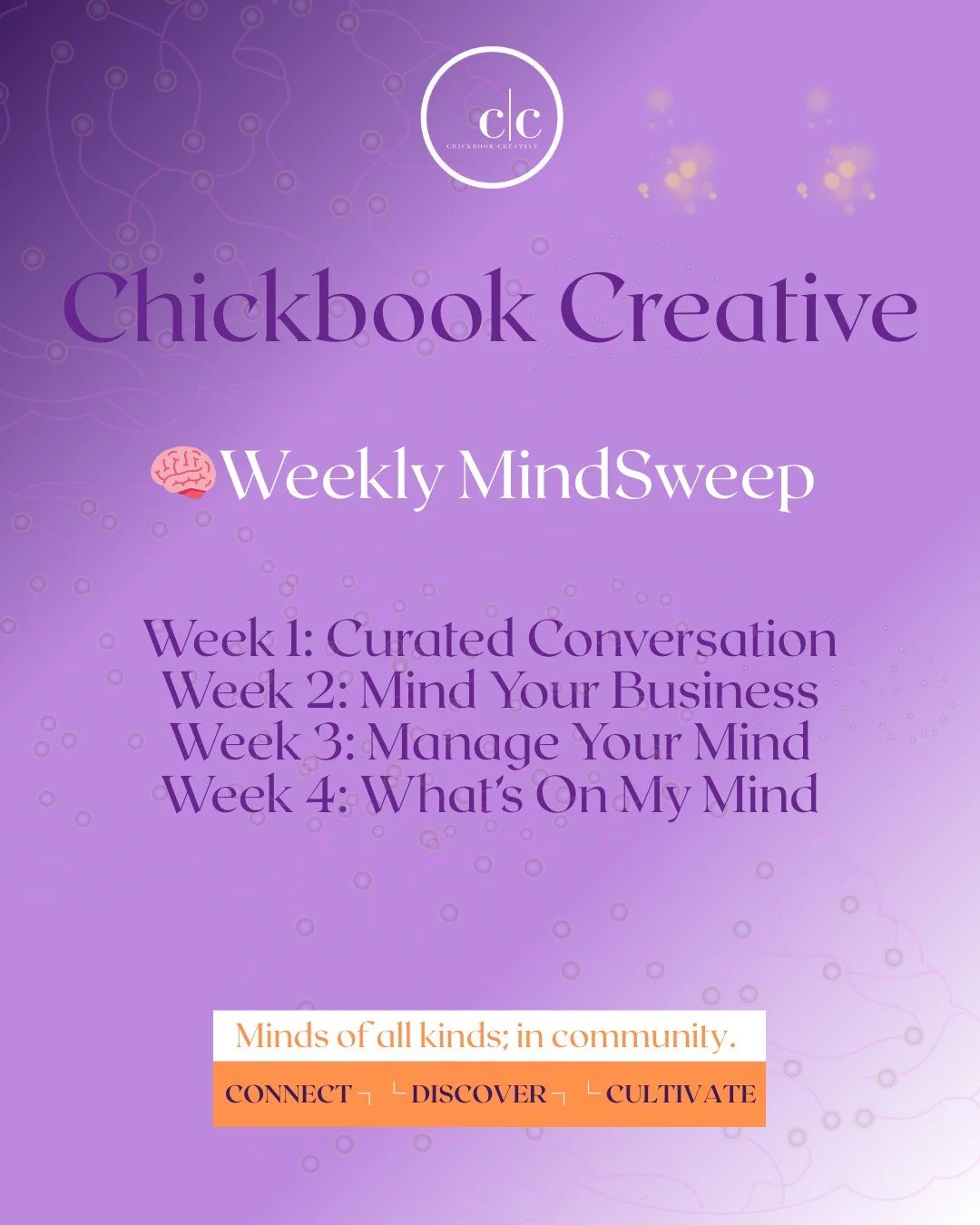
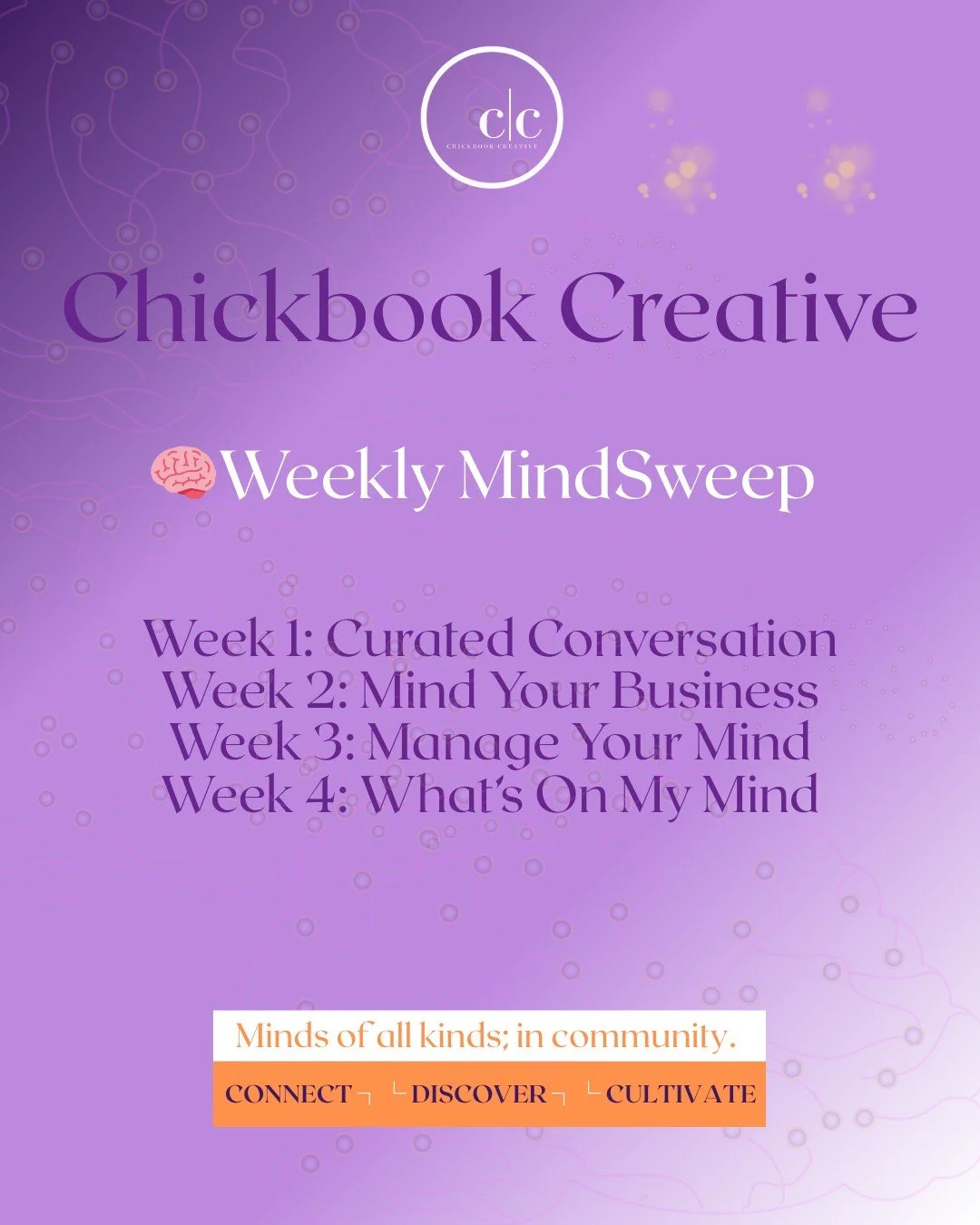
Week 220: Curated Conversation: Tolerance
*Week 221: Mind Your Business: Tolerance
Week 222: Manage Your Mind: Tolerance
Week 223: What’s On My Mind: Tolerance
New to the Weekly MindSweep? Past issues live here.
Let’s Sweep The Brain!
🎬 Rather watch or listen instead of read? Now you can!
Subscribe to YouTube @chickbookcreative
In the MindSweep this week:
Weekly MindSweep: Past issues live here.
Jamie’s Second Brain Corner: Links to references & MindSweep Mapping
What’s Inspiring Me - Into The Magic Shop by James R. Doty M.D.
My face and a link to schedule your free consultation.
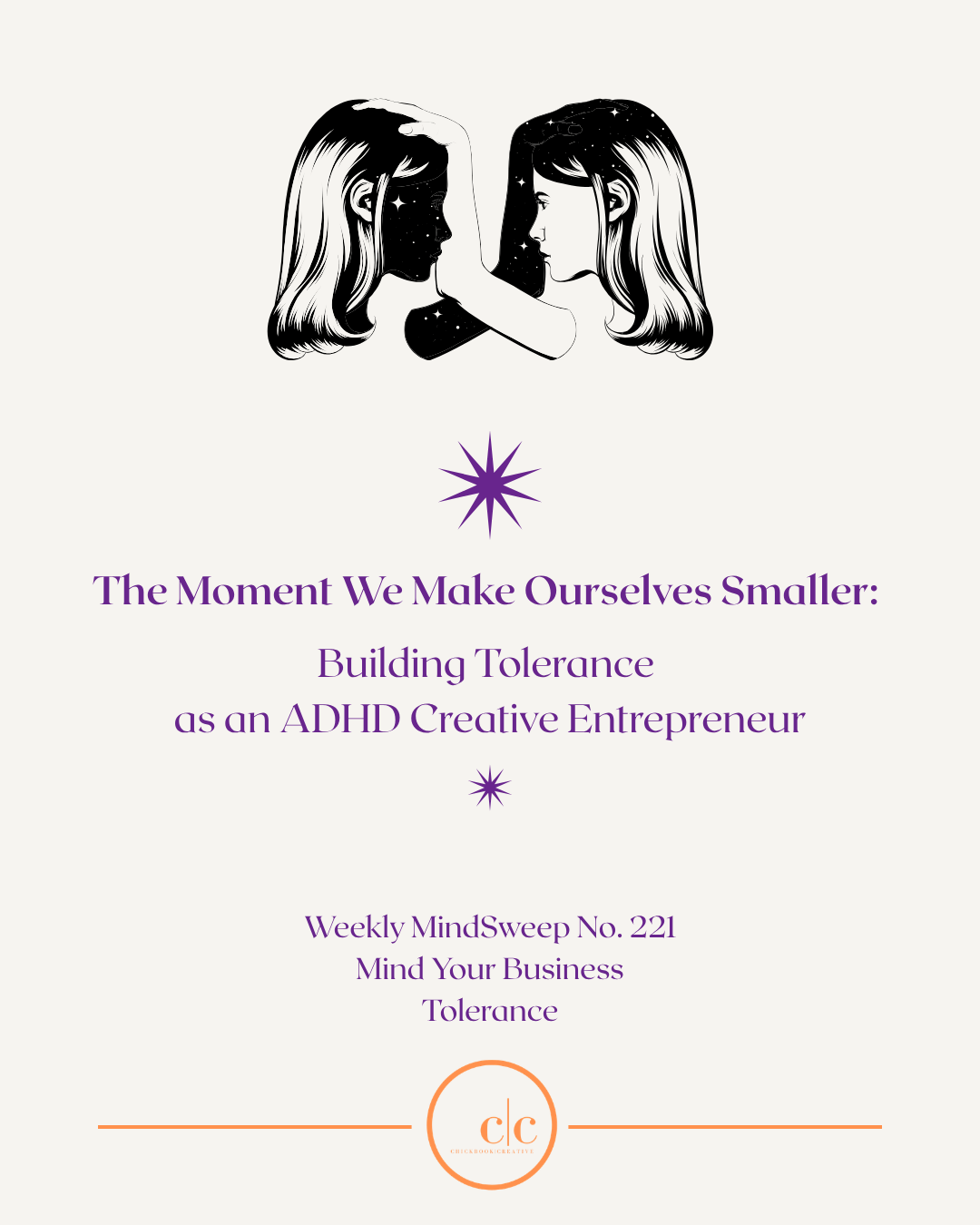
The Moment We Make Ourselves Smaller: Building Tolerance as an ADHD Creative Entrepreneur
The space between discomfort and your next move is where everything changes.
A few years ago, I had a client discovery call that I still think about now, 5 years into my business.
Everything was going well. The conversation was flowing, she was nodding along, and I could feel the yes building. She felt seen, heard, and understood, and it felt like she was finally ready to say yes to the support she needed for herself and her business to thrive. Then she said something my brain didn't expect. A small comment about her budget, about needing to "think it over," about how she'd worked with someone before, and it hadn't gone the way she hoped.
I felt a physical reaction: tightening, warmth leaving my chest, and a subtle posture shift. My mind began planning an exit before she even finished speaking.
I didn't leave the call, but I left the conversation.
Still on the call. I kept nodding and saying "absolutely" and "of course." But mentally, I was gone. My nervous system decided what her words meant. It was already writing the ending.
I got quieter. I softened my offer without her asking me to. I adjusted my language in real time, shrinking the work down to something smaller, something easier for her to say yes to, and easier for me to defend if she didn't.
I believed I was being attentive and responsive to her needs.
But I was really addressing my own discomfort. Unable to tolerate uncertainty, I made myself smaller to feel safe.
She didn't book.
I sat with my smaller, safer self, wondering why. And honestly, I'm not sure the version of me who showed up at the end of that call would have served her well.
What "Mind Your Business" Has to Do With Tolerance
Last week in Curated Conversation, we explored what tolerance is. It's not agreement, suppression, or quiet compliance. It's the active capacity to stay present in a challenging moment—long enough to choose your response, not just default to reflex.
That's a powerful idea in a conversation with people you trust on a Monday morning.
It's a different thing entirely inside your actual business.
Because in business, the discomfort doesn't arrive when you're ready for it. It arrives in the middle of a sales call. In the silence after you send a proposal. When a client pushes back on your process, when a project stalls, when the numbers say something you don't want to hear, when you're about to share something publicly, and every instinct you have says not yet.
This week, we bring tolerance off the cushion and into the work. Because what happened on that call and what I did weren't personal failures. It was a patterned response. And patterns, once you can see them, can change.
Where Tolerance Breaks Down in Business (And You Might Not Even Notice)
The tricky thing about intolerance in a business context is that it rarely looks like avoidance. It looks like professionalism. It looks like a strategy. It looks like you're making a smart, measured decision, but really, you're just trying to lower the temperature as fast as possible.
Here are some of the places it tends to show up:
In sales conversations, when a prospect hesitates, you may instinctively soften your offer, lower your price, or over-explain your value—even before they've finished their sentence.
In visibility, when you're about to post something real—something that shows who you are and what you do—you might pull back, rewrite until it's safer, or decide the timing isn't right.
In client work, when a project isn't landing the way you hoped, and rather than naming it, you keep adjusting quietly, hoping the tension resolves itself.
In pricing, when you decide what someone can afford before they've had a chance to decide that for themselves.
In receiving feedback, when a client or colleague says something critical and you immediately go into either defense mode or collapse, neither of which is actually listening.
In your numbers, when the data tells a story you're not ready for, and you find something more urgent to attend to instead. #laundry
None of these is a moral failure. They're nervous system responses. Your brain does what it's designed to do: sense discomfort and move you away from it, fast.
In business, the moments that need your presence are often when you most want to flee.
Tools and Practices for Building Tolerance in Real Time
Tolerance isn't an innate trait. It's a trained capacity, built through small, deliberate, and repeated practice
Here are some starting points for you this week:
Pause before you adjust. Next time you feel the urge to soften an offer, rewrite a post, or lower your rate mid-conversation, pause for five seconds first. You don't have to stay uncomfortable forever—just long enough to ask if you're responding to real information, or just managing your discomfort.
Need a smaller step? You don’t need to discuss pricing during an exploratory call. You can ask for space to consider what this particular client needs, and follow up in writing or on another call.
Name what's happening in your body first. Tolerance is a somatic experience before it's a mental one. When tension shows up — tightening in the chest, shoulders rising, a sudden urge to explain or apologize — name that internally. My nervous system is activated right now. That small act of naming can create just enough distance between the sensation and the reaction to make a different choice possible.
Need a smaller step? Keep a single word list nearby — tense, activated, braced — and just say it quietly to yourself when you feel the shift. You don't have to understand it yet. Just name it.
Separate the moment from the meaning. A common collapse occurs when we use a single moment—a "no," a silence, a slow launch, or a critical comment—as evidence of everything. The moment is data. It's not a verdict.
Need a smaller step? After a hard moment, write down just the facts — what actually happened, not the story you're telling yourself about it. One sentence: What occurred, without interpretation.
Create a pre-tolerance habit before high-stakes moments. If a big call, launch, or visible post is coming, your tolerance rises if your nervous system is prepared. That can mean a walk, stillness, or talking with someone who is grounding for your nervous system. #Me. Capacity grows when you tend to it.
Need a smaller step? Start with two minutes before the moment, not a full practice. Two minutes of slow breathing, a step into the bathroom alone, or one song that settles you. Small and consistent will always beat elaborate and occasional.
Build in a beat before you respond. In conversations — especially charged ones — give yourself a breath before you answer. Is this the response I want to give, or is this the first response that will make the discomfort end the fastest?
Need a smaller step? Give yourself permission to say "let me think about that for a second" out loud. It's not awkward. It's modeling exactly the kind of presence your clients are hoping to learn.
Review the moments you adjusted, not just the moments you spoke up. Tolerance work isn't only about the big stand you took. It's also about the times you quietly stepped back. The proposal you rewrote before you sent it. The offer you undersold in the room. The thing you almost said. Tracking your micro-adjustments is how you start to see the pattern.
Need a smaller step? At the end of the week, ask yourself one question: where did I make myself smaller than I needed to? Just notice. You don't have to fix it yet. Awareness always comes first.
What Becomes Possible When You Stay
I've replayed that discovery call enough times to know the exact moment I lost my footing—when she said she'd worked with someone before, and it hadn't gone well. I heard hesitation, immediately took it as rejection, and spent the rest of the call trying to fix a problem that hadn't actually happened.
What I couldn't tolerate was the uncertainty. The gap between where she was and where I hoped she was going. That space felt dangerous, so I closed it by shrinking.
What might have happened if I had stayed?
I don't know, exactly. Maybe the same outcome. Maybe a different one. But I don't think about what I would have gained if I had stayed. I think about what she didn't get. The version of this work that might have actually changed something for her. I made myself smaller before she ever asked me to.
Tolerance in business doesn't mean certainty or guaranteed outcomes. It brings clearer information, steadier decisions, and a sense of presence. This builds trust with clients and yourself.
Tolerance in business isn't about enduring more. It's about staying long enough to see what's actually true, rather than acting on what your nervous system assumes is about to happen.
Before your next high-stakes moment — a call, a post, a proposal, a conversation you've been putting off — ask yourself:
Where am I most likely to adjust, leave, or shrink before I even know what's being asked of me?
That's the edge. That's where the work is.
And that's exactly where we'll be spending this week together.
My questions for you this week:
What would it mean for your clients if you stayed fully present in your next high-stakes conversation instead of managing the outcome in advance?
Where are you currently making yourself smaller before anyone has asked you to? And what would it look like to stay in that moment just 10% longer than you normally would?
Reply and share with me!
✨ You Belong Here. I can help.
What Would Have Happened If You Had Stayed?
I spent years asking myself that question after calls, proposals, and moments where I made myself smaller before anyone asked me to.
What changed wasn't willpower. It was structure. It was understanding what my nervous system was doing and building a business around that reality instead of fighting it.
That's the work I do with creative, ADHD-wired entrepreneurs — translating the space between reaction and response into clear strategy, sustainable systems, and the kind of presence that actually builds trust with your clients and yourself.
If you know what you want but keep finding yourself one step back from claiming it, let's look at that together.
Curated Conversation
You Read It. Now Come Sit In It.
This week inside Curated Conversation, we're taking everything in this post off the page and into real time.
Because reading about tolerance is one thing. Practicing it — out loud, with other people who get it — is where something actually shifts.
Every Monday at 8am, a group of heart-centered, ADHD-wired entrepreneurs shows up to do exactly that. We slow down. We name what's actually happening. We ask the questions that are easier to avoid. And we do it together, without judgment, without needing to have it figured out, and without rushing to resolution.
Come listen if that's all you have. Come speak if you're ready. Stay if it feels like home.
Mondays at 8am. Your first month is free.Coffee encouraged. Belonging included. 💜
Was this blog forwarded to you? Sign up!
Jamie’s Second Brain Corner:
Words in bold within the Weekly MindSweep are all topics we’ve covered in Curated Conversation. You can dig into them here by searching for the word.

What I’m reading
Into the Magic Shop. A Neurosurgeon’s Quest to Discover the Mysteries of the Brain and the Secrets of the Heart
by James R. Doty M.D.
I’m inspired by the idea that the words we choose, especially the ones we quietly repeat to ourselves, are more than just thoughts.
They’re instructions that shape what we believe is possible.




In other news…
Feeling #FOMO about Curated Conversations? Join us!