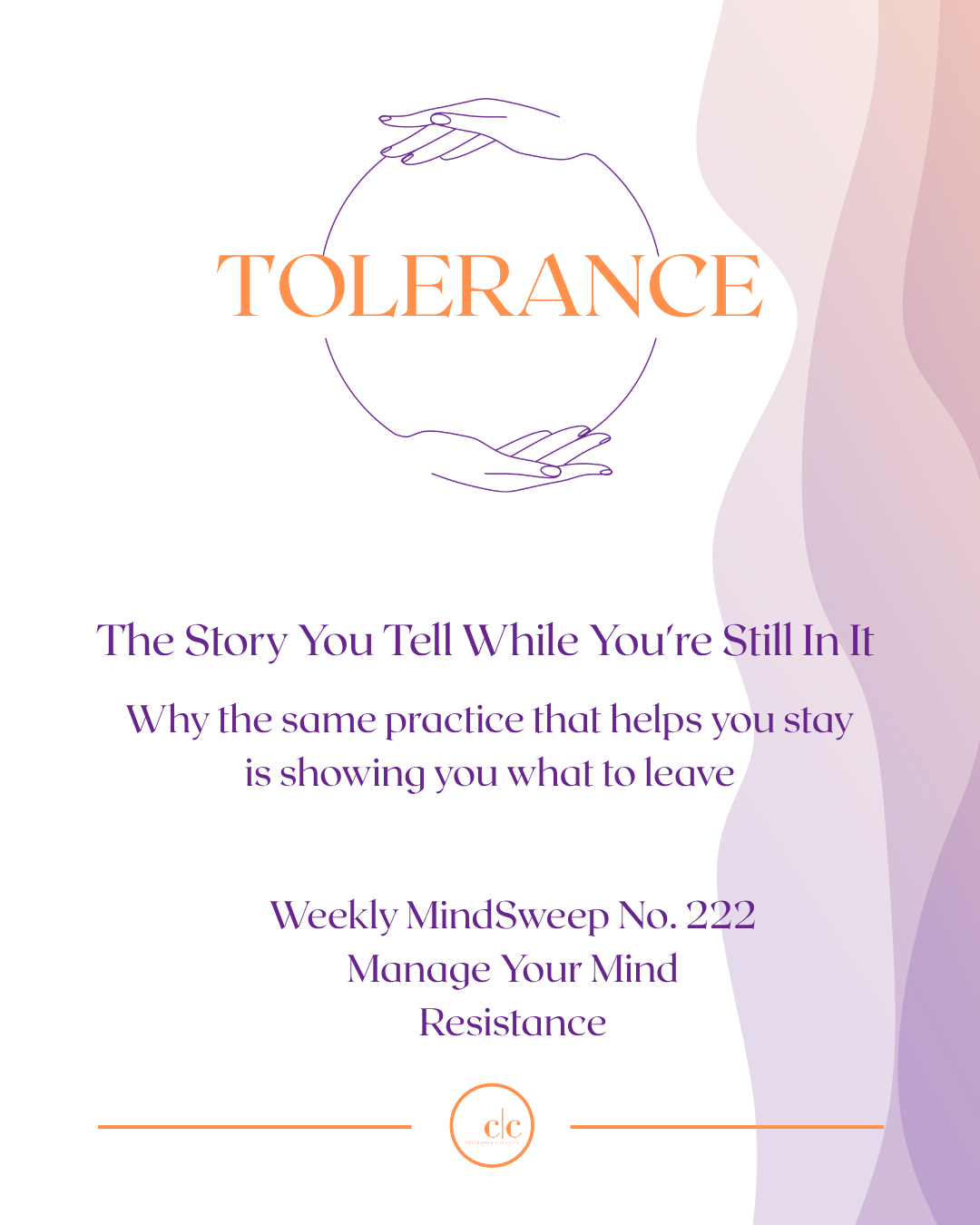
🧠 Weekly MindSweep No. 222 | Manage Your Mind | Tolerance
April 2026
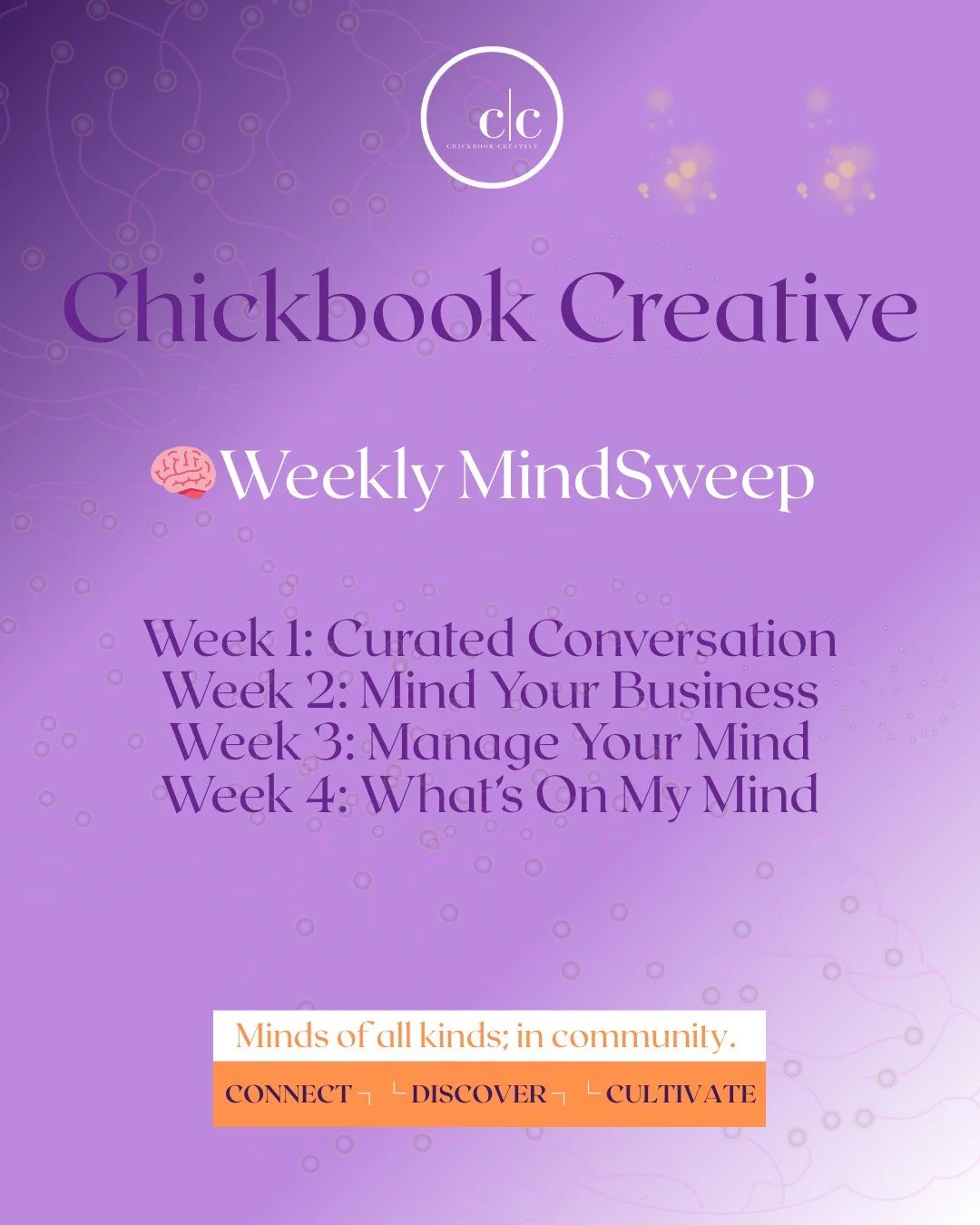
Week 220: Curated Conversation: Tolerance
Week 221: Mind Your Business: Tolerance
*Week 222: Manage Your Mind: Tolerance
Week 223: What’s On My Mind: Tolerance
New to the Weekly MindSweep? Past issues live here.
Let’s Sweep The Brain!
🎬 Rather watch or listen instead of read? Now you can!
Subscribe to YouTube @chickbookcreative
In the MindSweep this week:
Weekly MindSweep: Past issues live here.
Jamie’s Second Brain Corner: Links to references & MindSweep Mapping
What’s Inspiring Me - Into The Magic Shop by James R. Doty M.D.
My face and a link to schedule your free consultation.
The Story You Tell While You're Still In It
Why the same practice that helps you stay is showing you what to leave
Over the last several weeks, we've been building a specific kind of muscle. The capacity to stay present when discomfort arrives. To notice the moment your system tightens and your thinking narrows and to pause there, rather than follow the reflex out the back door.
We've been practicing how to tolerate discomfort.
And, the same awareness you build to help you stay in the moments that matter also makes certain other things impossible to ignore.
Maybe it's a client relationship that's been wearing you down for longer than you want to admit. Or the way you feel you have to explain yourself in situations where you shouldn't need to. Or perhaps it's a standard you've accepted in your work or self-talk that you would never accept for someone you care about.
The same muscle that helps you stay with creative friction? It's now showing you where you've been staying out of habit or conditioning. Out of a very old, very practiced form of self-protection that looks like patience but functions more like disappearing.
This is the paradox at the center of this work:
Tolerance as a practice expands you. Tolerance as a survival strategy contracts you.
One is something you choose. The other is something that happened to you, and it kept happening, quietly, until you stopped noticing it was happening at all.
We are practicing both at the same time right now. And this week's work is learning to tell the difference.
What Your Brain Is Actually Doing
Let’s look at what’s happening in your brain.
Your brain is not built for uncertainty; it's built for efficiency. Every moment it can't categorize quickly is a moment it registers as a potential threat. So when something uncomfortable shows up, like friction in your creative process, silence after a pitch, or feedback that doesn't land the way you hoped, your amygdala registers it before your thinking brain has a chance to weigh in.
The flag goes up. The body responds. Your shoulders rise, your chest tightens, and your thinking narrows.
Your prefrontal cortex—the thoughtful response center—goes partially offline, prompting you to act from your default mode network. #Habits
Which means the story your brain tells in that moment is not coming from your wisest thinking. It's coming from a system designed to get you to safety as fast as possible.
If you have a creative, multi-passionate, or ADHD brain, this process can feel even stronger. Researchers call it reward deficiency, meaning your brain needs more stimulation to feel satisfied. When a task goes from exciting to routine, your discomfort can feel almost unbearable. The chemicals that help you stay balanced are already low, so when you reach your limit, the urge to leave a project or tough situation can feel like a physical necessity.
That urge is a signal, not a final decision.
And it doesn't point only to the creative work you're avoiding. It also points toward the things you've been living with for so long, and so quietly, that your nervous system stopped flagging them as problems, and started treating them as the cost of doing business with your clients, with the world, and with yourself.
Two Kinds of Staying
Before we continue, it's important to be clear: the word tolerance is doing two very different jobs right now, and mistaking them is where we can get lost.
The first kind of staying is what we've been practicing. The capacity to remain present inside discomfort that belongs to growth. The friction of creative work that hasn't yet been resolved. The uncertainty of a new offer before the market has responded. The vulnerability of saying something real before you know how it will land. This discomfort is not a signal that something is wrong; it’s a signal that something is new. And learning to stay with it, and not to immediately flee, fix, or shrink, is how you expand your capacity over time.
The second kind of staying is different. It's what happens when you've absorbed a situation, a dynamic, or a standard for so long that your nervous system stops registering it as uncomfortable. Not because the discomfort went away, but because you’ve adapted to it. You made it normal. You built your whole operating system around it. Your communication style, your pricing, your boundaries, your self-talk, and at some point, it stopped feeling like tolerance and started feeling like just how things are.
The same awareness you've been building to help you recognize and stay with the first kind of discomfort? It's starting to illuminate the second kind, too.
And that's not a detour from this work. That is the work.
The Stories Your Mind Tells in Both Directions
Your mind creates stories whenever you feel discomfort, no matter what kind of staying is needed. The same three narratives show up, sometimes pushing you out of the room when you should stay, and sometimes keeping you in the room long past the point when staying serves you.
Here are three common stories you might recognize.
The Verdict Story
This isn't working. This isn't going to work. This was a bad idea.
In creative work, the Verdict Story often shows up before you have real evidence. It turns a small challenge into a final judgment. If a project stalls, you might think, "This isn't meant for me." If your idea doesn't work out as planned, you might tell yourself, "I was wrong to think I had something to offer."
But the Verdict Story can also work the other way. It's the voice that says, "This is just how this client is," or "This is what working for yourself is like," or "I've tried to change this before, and it didn't work." It's the same kind of story, giving you false certainty, but now it's about something you've been tolerating instead of something you're trying to create.
The Prediction Story
I already know how this is going to go.
In creative work, the Prediction Story jumps ahead to an imagined future and uses that to justify quitting before you really start. You might think, "I can already see where this is going," or "I know this won't work." It feels like wisdom, but it's not. It's your brain trying to avoid uncertainty by deciding the outcome in advance.
When it comes to things you've been tolerating, the Prediction Story might sound like, "It would be worse if I spoke up," "I've tried before," or "They won't change." It's the same pattern, but now it keeps you stuck—not because staying is best, but because change feels scarier than what you already know.
The Confirmation Story
This is just more evidence that I was right to be worried.
In creative work, this story takes any new challenge and adds it to an old narrative about yourself. You might think, "See? This always happens to me," or "This is why I never finish things." It's not really recognizing a pattern; it's just reinforcing an old belief.
When it comes to things you've been tolerating, the Confirmation Story can be the most subtle. It makes challenges feel unavoidable. You might think, "Of course this is hard," or "This is just how my life is." It sounds like self-awareness, but it's really a way of holding yourself back that you've repeated so often it feels true.
The Practice: Staying With Intention
So how do we practice staying with intention?
Mental tolerance isn't about forcing yourself through discomfort or ignoring your thoughts. It's about learning to see your thoughts as interpretations, not facts, and staying present long enough to ask yourself:
Is this discomfort a sign to stay and grow, or a sign to move on?
This question isn't always easy to answer, but it's always worth asking. Learning to tell the difference is what turns tolerance from a habit into a conscious practice and intentional choice.
Here are five practices you can try this week to help you build awareness and discernment around tolerance:
1. Name the story type, not just the feeling.
When you feel discomfort and your mind starts telling a story, try to figure out which type it is: Verdict, Prediction, or Confirmation. Then ask yourself: Is this story pushing me away from something I'm building, or keeping me stuck in something I've outgrown? Naming the story helps you separate yourself from it. Remember, you are not the story. You are the one noticing it.
2. Find the next true thing.
When your thoughts are overwhelming and you feel stuck, don't try to solve everything at once. Instead, focus on the next thing you know is true right now. For example: 'I'm at my desk.' 'This project exists.' 'I haven't finished yet.' Or, 'This situation has been tough for six months.' 'I've noticed it three times this week.' That's a pattern, not just a feeling. Come back to what's real before deciding what it means.
3. Ask: What would I need to see before I made this conclusion?
This question is useful in both directions. Before you decide the creative work isn't working, what evidence of working would you actually recognize? How long have you been in it? Before you decide a situation is just how things are, when did you last genuinely examine that assumption? How long ago did you stop asking whether it was still acceptable?
4. Interrupt the confirmation loop.
When you notice the Confirmation Story, ask yourself honestly: Is this really a pattern, or am I just picking evidence to support a belief I already have? Patterns are real, both in your creative work and in what you've been tolerating. But it's also human nature to stop questioning things we've already decided are unchangeable. #Bias
5. Stay ten percent longer than your reflex says to and leave ten percent sooner than your habit tells you to.
When you're facing the discomfort that comes with growth, try staying just a bit longer than your first instinct tells you. Give yourself time to see if there's more beneath the surface. When it comes to discomfort from things you've been tolerating, try leaving, naming, or changing the situation a little sooner than you usually would. Both actions are forms of tolerance and use the same skill. The only difference is which direction you apply it.
What Noticing Also Reveals
Over the past few weeks, we've been learning how to stay present. We've practiced noticing resistance and choosing our next step, instead of just reacting automatically.
Now, something that wasn't clear at the beginning is becoming obvious.
When we sharpen our ability to notice what we're feeling — to name the moment our systems tighten, to identify the story our mind is generating, to stay present rather than immediately exit — we also begin to notice what we've been carrying. Quietly. Consistently. For much longer than we realized.
The standard you set for how people speak to you in your business: when did you decide that was acceptable?
The way you explain, justify, and defend your work and your prices: who taught you that was necessary?
The inner voice that narrates your creative process with criticism rather than curiosity: when did that become the default, and have you ever consciously chosen it?
These are big questions, and they're closely connected to this month's theme. They're just another side of the same idea.
Tolerance that you choose and practice on purpose, especially when it helps you grow, is one of the most powerful things you can develop.
But tolerance that you've picked up unconsciously or accepted from others without thinking about it is worth examining now. Do this without judgment or rushing—just with the same presence you've been practicing.
The same awareness that helps you stick with something important will also help you see when it's time to move on.
This Week, Bring Both
We are practicing two things at once right now.
Building the capacity to remain present with the discomfort of creating, growing, and showing up.
And developing the clarity to see what we've been living with, in our business, in our relationships, in our own self-talk, that we no longer want to carry.
Both of these are forms of tolerance and need the same skill. They both start at the same moment—right after discomfort shows up, before your mind creates a story, when you can still ask yourself what's really true.
This week, bring both.
My questions for you this week:
Where is discomfort asking you to stay, and where is it asking you to go?
What have you been calling "just how things are" that you're now seeing differently?
Reply and share with me!
✨ You Belong Here. I can help.
If you saw yourself in any of those stories or have been wondering if you’re staying somewhere longer than you should, I can help you figure out your next steps.
This is what I do.
As a brain-based business strategist, I work with creative entrepreneurs with ADHD to help them tell the difference between the kind of discomfort that leads to growth and the kind that just keeps you stuck. Together, we build awareness, structure, and strategy so you can move forward without losing yourself along the way.
If you’re ready to take a closer look at what you’re building or what you’ve been carrying, let’s talk.
Curated Conversation
You Read It. Now Come Sit In It.
This week inside Curated Conversation, we're taking everything in this post off the page and into real time.
Because reading about the stories your mind tells is one thing. Recognizing them out loud in the middle of a real conversation, with people who already know exactly what you mean, is where something actually shifts.
Every Monday at 8am, a group of heart-centered, ADHD-wired entrepreneurs shows up to do exactly that. We slow down. We name what's actually happening. We ask the questions that are easier to avoid. Including the ones about what we've been staying in a little too long.
We do it together. Without judgment. Without needing to have it figured out. Without rushing to a resolution.
This week, we're bringing both. The discomfort that's asking you to grow. And the thing you've been calling "just how it is" that you're starting to see differently.
Come listen if that's all you have. Come speak if you're ready. Stay if it feels like home.
Mondays at 8am. Your first month is free. Coffee encouraged. Belonging included.
Was this blog forwarded to you? Sign up!
Jamie’s Second Brain Corner:
Words in bold within the Weekly MindSweep are all topics we’ve covered in Curated Conversation. You can dig into them here by searching for the word.

What I’m reading
Into the Magic Shop. A Neurosurgeon’s Quest to Discover the Mysteries of the Brain and the Secrets of the Heart
by James R. Doty M.D.
I’m inspired by the idea that the words we choose, especially the ones we quietly repeat to ourselves, are more than just thoughts.
They’re instructions that shape what we believe is possible.




In other news…
Feeling #FOMO about Curated Conversations? Join us!